


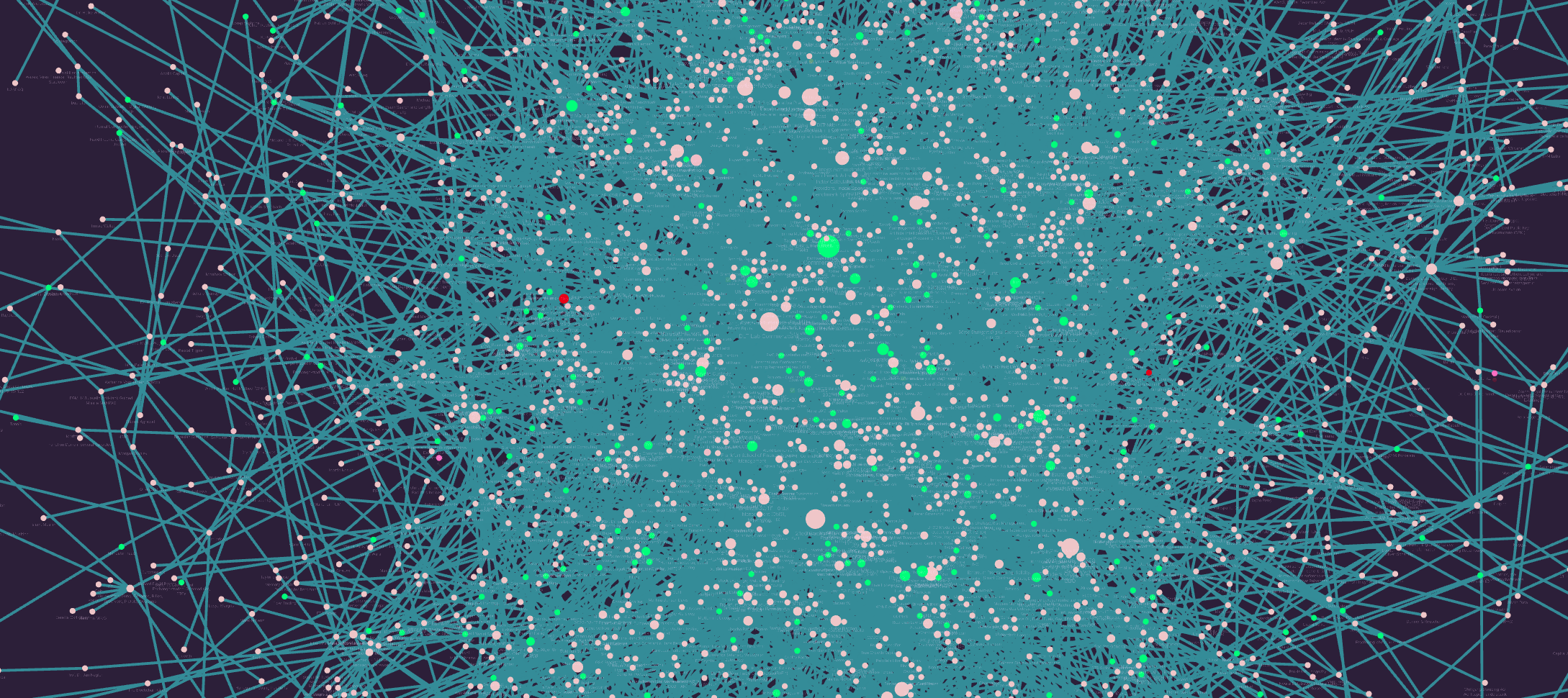
A year or two back, you rediscovered note-taking. Got Obsidian, Roam, Logseq, or some other tool installed. Watched a few videos on Zettelkasten and started to see connections everywhere. Since then, you’ve been diligently adding notes to your system. Summaries of books you read, highlights conveniently copied over thanks to Readwise, random ideas and observations, journal entries… After a while, your notes started to add up, thousands of them. You installed a dozen plugins, watched another dozen videos. You’re starting to see your graph evolve, slowly developing into something that looks like a nervous system. But outside of that, nothing has really changed.
“If only I could just get everything in the system, then I can start to think with it.” That’s what you’re thinking, right? Wrong.
Your second brain is just a hard drive.
A very expensive and flashy hard drive, but a hard drive nonetheless.
Nothing happens when you write to disk. Nothing happens when you add notes to your notes app. Storing is not thinking. In machine learning, models don’t learn from data. They learn from making predictions, evaluating how wrong those predictions were, and using that information to update themselves. No prediction, no evaluation, no learning. When you copy a paragraph from a PDF into your notes app, nothing happens. You haven’t processed that information. You haven’t moved forward.
I know, I know. I’ve built these things too. There’s a magic to saving – or even just creating – something. (Even if it’s just a wrapper around a quote from somebody else.) This is all the “Collector’s Fallacy” (Zettelkasten terminology from a few years before it was cool) stuff that said “To collect is the reward in itself”. You can go digging and bookmark half the internet and feel smart – even if you never even read the article to start with.
That’s the difference between learning something and learning about something. So many smart people fall into this trap because collecting is safe. Writing is not. Putting your quotes in your vault is safe because nobody can say that your folder of other people’s quotes is wrong. Synthesis is much riskier. You have to sit down, look at the blank screen, and come up with an idea. A really stupid one, a cliché, something your friend is definitely going to be mad at you for, something X might laugh at, or something that makes you uncomfortable even to think about.
This discomfort isn’t a side effect; it’s the whole point. If you know anything about the note-taking world, you’ve probably heard of Luhmann, the German sociologist and the original granddaddy of your vault backlinks. He wrote a massive body of work – dozens of books, hundreds of articles – using his Zettelkasten made up of about 90,000 index cards organized into twenty-seven drawers. He credits the box for his productivity.
But going by the contents of his drawers, they weren’t a highlight dump. The digitized Luhmann Archive tells us that about 75,000 of his cards were substantive notes. In other words, Luhmann wasn’t just taking down what he read; he was writing down his thought process, his conceptual progression. In short, the majority of the box was his own words – bits of his own thoughts, half-formed theses – written over the course of forty years, night after night, and then transcribed into articles and books. He began this second collection in 1961, and added to it until early 1997, about a year and a half before he passed.
He wasn’t collecting quotes. He was writing books. Merely replicating his system – especially the little cardboard drawers – is straight-up cargo cultism. But surely the linking is the secret sauce, and this is why Roam Research raised nine million dollars for a roughly $200 million valuation in 2020, right? Dan Shipper’s 2022 article “Wiki-links are a cognitive tool” nails it…right?
Except in “The Fall of Roam”, he basically admitted that he’d been using the app as sort of an anxiety pill, endlessly shuffling and interlinking his notes instead of writing them until he finally abandoned it and found himself with a garbage dump of links and text he almost never opened again. He spent months making connections to stuff he never used. Writing stuff down is a superficial sense of structure; it’s really just procrastination. The anxiety returns; the links don’t help.
Which is why I don’t trust any note system being marketed primarily on the basis of its graph visualization. A constellation of nodes and edges doesn’t equal thinking. Until you can put a connection into words, it’s meaningless. The way to fix this is much easier than you’d think – just stop optimizing your box and start writing small. Stop worrying about what you’re reading. Instead, write a few hundred words in your own words about your own thoughts – especially what you don’t know yet, or where your reasoning falls apart.
That’s it. That’s thinking. That’s the hard part. It doesn’t exist in any other form. Only take notes if they’ll be useful for an actual project; archive or delete the rest. Tiago Forte – author of the book Building a Second Brain, now 100,000 copies strong – based his entire method on this. So do all the honest productivity people: only save what resonates, process it, and keep your system small. Make it hurt. Make it small.
When you do this, the goal becomes tangible. No sane person judges a lab by the size of its hard drive; now you’ll evaluate yourself by what you’ve actually created each month – essays, decisions, code, arguments you’ve actually defended. A vault of 300 notes that produced two essays is better than a vault of 5,000 notes that makes you feel organized. Archiving isn’t the goal; it’s an analgesic. It’s the pill, not the action.
Not to say tools are bad. Obsidian is still brilliant. It’s an incredible editor. Markdown is nice. Linking is nice. The plugin ecosystem is genuinely fun. But it was never about tools. It was about the fantasy of offloading your brain. Intelligence isn’t a filing cabinet; it’s a loss function.
It’s making mistakes in public and learning from them. Only your first brain can do that, and it does so with friction. So don’t install another plugin, or read another article about the best way to structure your folders.
Start with a blank page and an opinion.
Even if it’s a stupid one.
Lord knows, you’ll at least be in company with me.
🍕 I’m JA Westenberg. I write essays about technology, philosophy, productivity, and what it means to be human. If you’re an optimist, you’re in the right place. You can read my AI disclosure here
Work with me:
