🍕 I’m JA Westenberg. I write essays about technology, philosophy, productivity, and what it means to be human. If you like ideas that take their time, you’re in the right place. You can read my AI disclosure here.
A reminder: if you sign up as a paid annual member, you get a free digital copy of my book Unsanctioned.
If you become a paid Founding member, you also get:
A digital copy of my book Permissionless
One free year of Post Through It
One free year of Kerouac
Upgrade your subscription, claim your perks, and support independent work for the long haul.
The ultimate cowardice of our time is the refusal to care; the abdication of any impulse to actually give a s**t.
For roughly thirty years, we have flattered ourselves that our indulgence of apathy is actually a sign of our sophistication. We perform it as a morally admirable posture, and we act as if anything sincere or effortful is cringe and can only be met with an ocean of ironic distance.
Our reflex is the raised eyebrow and a smug half-smile that insists I, an enlightened one, have seen through all of this, conveniently sparing us from ever having to articulate what precisely we have seen through, or what we actually stand for.
I’ve been as guilty of it as anyone.
I’ve delivered world-weary assessments of things I secretly found thrilling. I’ve used the vocabulary of thoughtful // elevated // intellectualized critique to avoid showing any enthusiasm. You probably have, too - and you might even remember the exact social calculus you were running: enthusiasm makes you vulnerable to embarrassment; detachment risks nothing.
Detachment is safe.
…too safe.
Too safe to achieve anything at all.
There’s a French word I find aspirational: élan. It translates roughly as vigor // dash // spirited forward motion; an energy that doesn’t wait to see whether everyone agrees before committing.
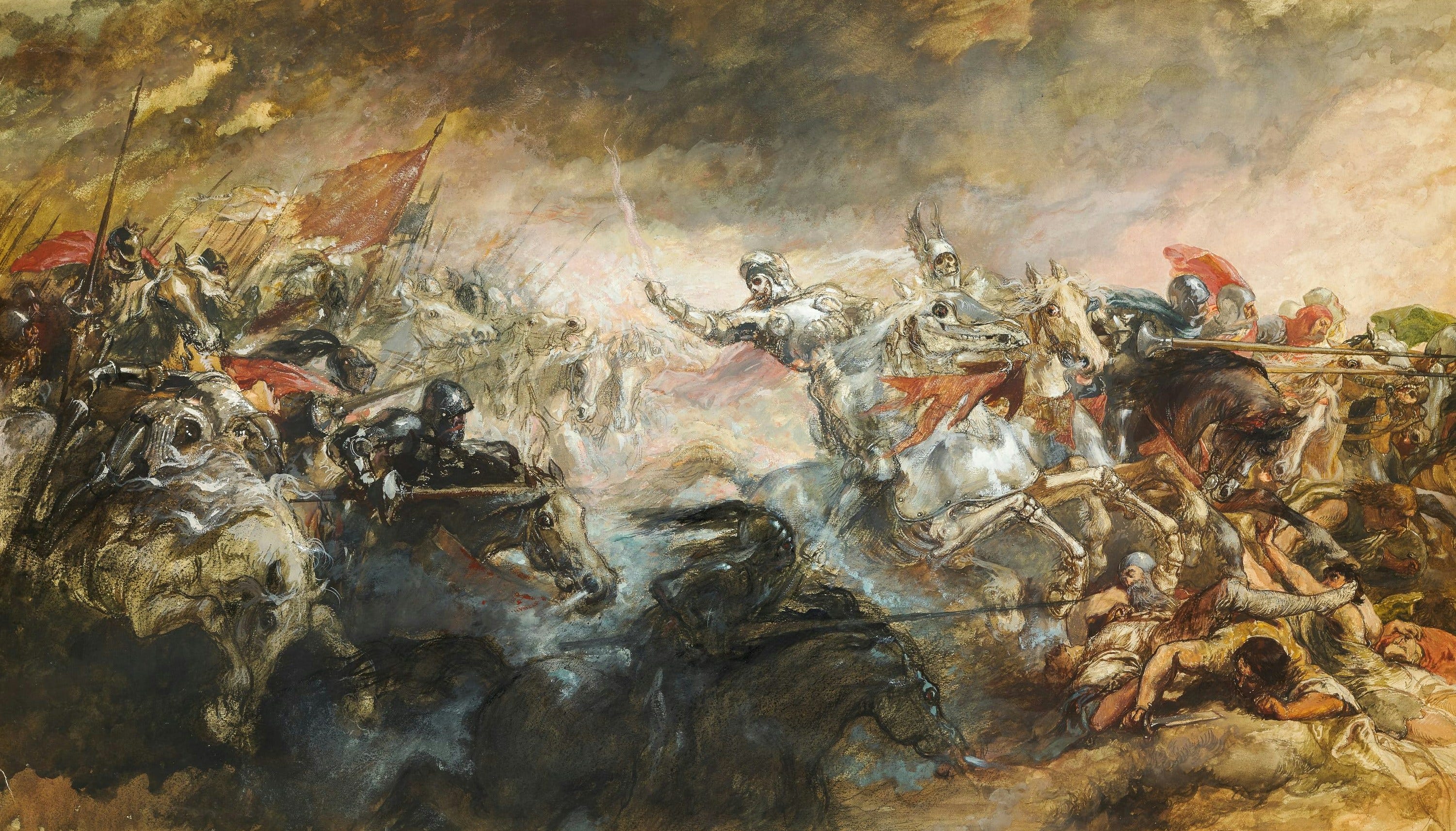
The French army’s doctrine of élan vital in the years before 1914 held that aggressive offensive spirit could overcome material disadvantage through sheer force of committed movement. This was, in the specific case of World War One, catastrophically wrong, and the newly invented machine gun had a great deal to say about it.
But military failures and glories do not invalidate the psychological reality at the core of this idea: Given the right environment, a profound, almost elemental power can surge through anyone anchored by absolute belief. It’s a force of nature that moves without seeking permission from cynicism, striking decisively before the critics can haul their asses off the couch to adopt the higher ground.
I want that back.
I think we need it - all of us - quite badly.
The Intellectual Case for Detachment Was Always Weaker Than It Looked
David Foster Wallace captured a generational spiritual exhaustion in his 1993 essay “E Unibus Pluram.” He identified a culture suffocating under the weight of its own reflexive cynicism. Irony, he observed, had mutated. What started as a vital, rebellious tool used by cultural critics to dismantle hypocritical authority had been entirely co-opted by the very institutions it was supposed to critique.
Television popularized the ironic smirk; by integrating self-mockery into its own commercials and sitcoms, mainstream entertainment immunized itself against outside criticism. The viewer was constantly invited to be in on the joke, comfortably seated above the earnest, uncool masses. But Wallace saw the danger. He saw how mass media produced detachment as an absolute defense mechanism against the vulnerability of ever having to be sincere or to say what you actually believe.
When the eye-rolling, detached posture becomes the default lens for educated life, we lose the capacity for earnest connection. We become paralyzed by the fear of looking foolish. If the ironic stance was the only available oxygen, Wallace asked, how could art survive without choking on its own cleverness?
He was entirely right to be terrified.
It was an anxiety that became the defining conflict of his life’s work.
Novels like Infinite Jest and his body of essays were deliberate, agonizing attempts to model how a hyper-aware mind could still punch through the membrane of modern detachment and reach a state of empathy.
Wallace wanted to rescue human sentiment from the trash bin of intellectualism.
It was a Herculean effort to force an unironic emotional exchange with the reader.
The results of that lifelong crusade were sometimes messy and exhausting, but they were - relentlessly, astonishingly - alive.
The political (and thus en vogue) argument for detachment goes something like this: uncritical enthusiasm always enables bad things. Nationalism, for instance. Various mass movements. The crowd psychology that Gustave Le Bon documented in 1895, which theorized how individuals submerge their critical faculties in collective emotion and become something frightening.
If you want to resist being swept up in dangerous enthusiasms, you have to cultivate a certain vigilant removal. You have to stay outside the crowd.
You can never, must never, let yourself be moved.
I’m not arguing for naive surrender to every available enthusiasm, and I’m not arguing that the 20th century’s catastrophes were unconnected to the emotional mobilizations that enabled them. Mass violence does require mass enthusiasm as a fairly foundational ingredient, and the cynics who warned against it weren’t entirely wrong.
And sure!
Vigilant detachment might indeed inoculate you against dangerous fanaticism!
But it also insulates you from grace.
A person who refuses to be moved by beauty - choosing to clinically dissect its ideological implications instead of doing anything actually useful - achieves no greater safety than the blind enthusiast; they just sentence themselves to a drabber (and “scoldier,” if that’s a word) existence. Scale this up, and a community that meets every shared project and every ambition with reflexive suspicion and relentless deconstruction won’t become any more righteous. It’ll become paralyzed, producing less, and stripping whatever it does manage to build of any joy.
What Detachment Actually Costs
Theodore Roosevelt’s 1910 Sorbonne speech - famous for the “man in the arena” passage - has been quoted so endlessly (and without a shred of context) that its original edge has been worn smooth. But read the speech in its entirety, and you’ll find an idea that seems to make the modern intellectual deeply uncomfortable: an unapologetic defense as intrinsic goods, entirely divorced from the outcome. Roosevelt never claimed that sheer effort guaranteed a win. He argued that the individual who acts and fails is inherently more admirable than the one who safely observes and dissects - because the arena, with all its ruin and exertion, is the crucible of human dignity.
This is not a complicated idea, but contemporary culture has a lot of trouble holding on to it.
We’re much more comfortable acting on the meta-level: discussing how commitment works, analyzing what drives people to care about things, situating enthusiasm within “structures of power,” etc.
Etc.
We’ve built elaborate frameworks for looking at effort from the outside, and much less capacity for the inside experience of it.
I notice this in myself when I write something I actually believe in. Before I publish a single tweet or a single blog post, my ironic self wakes up and starts cataloging the ways this could be embarrassing: someone smarter has made this argument better, the evidence could be read differently, who the f**k am I to say, how dare I use AI tools, etc etc etc. This is, I’ve come to realize, not actually intellectual humility. Intellectual humility would be open to specific counterarguments. This is closer to a preemptive retreat, trying to put enough critical distance between myself and my work so that any failure can be survived with self-concept intact.
The cost is that the work is worse.
You can always tell when someone wrote around their conviction instead of through it.
And the cultural cost is even larger. A society in which the most publicly respected intellectual position is to refuse to have skin in the game produces a toxic feedback loop: ambitious people learn to act detached, institutions reward detachment, and sincere enthusiasts either hide their enthusiasm or are pushed to the margins.
The people who most visibly believe in things become the objects of ironic analysis rather than participants in the conversation.
We treat them as clowns.
What fills the vacuum?
Cynicism that aspires to be cataloged as realism, and an exhausted functionalism where the only value is efficiency.
Which turns out to produce its own problems, because efficiency is a means to ends, and if you’ve evacuated the cultural capacity to care about ends, efficiency just optimizes faster toward nowhere.
A Defense of Caring, Loudly, About Things
Henri Bergson, who coined élan vital in 1907, used the concept as a passionate argument against the mechanistic view of life - against the idea that organisms and consciousness could and indeed should be fully explained by physical laws applied to inert matter. Élan vital was the creative impulse in life itself, the force that drove evolution to produce novelty rather than merely optimize existing forms. Consciousness, for Bergson, was not a byproduct of matter; it was an expression of the creative surge.
I’m not asking you to sign on to Bergson’s metaphysics. Philosophy of mind has moved considerably since 1907.
But surely anyone can feel the difference between moving through the world as a live and committed agent, and moving through it as an observer of your own passage. The creative surge Bergson was trying to articulate is real, and we’ve all felt it.
My best work has always felt like that surge.
I’m not making a case for uncritical enthusiasm, or for credulity, or for the suspension of judgment. I’ve read enough history to know that sincerity in service of bad ends is worse than nothing.
But there’s a difference between disciplined commitment and naive enthusiasm, and we’ve allowed the fear of the latter to crowd out the former.
The writers who changed how people understood the world- from Orwell writing about coal mines and Spanish trenches, to Baldwin writing about race and American self-deception, to Sontag writing about photography - all shared this quality: they put their actual views on the line. They could be challenged and sometimes were. They updated when they were wrong. But they started from commitment, not from the practiced performance of having zero stake.
What I Want
I want a culture that again treats commitment as a virtue, that finds something admirable in the person who visibly cares about what they’re working on, that allows enthusiasm to exist without immediately asking which ideology it serves or what it’s selling.
I want intellectual culture to stop rewarding the performance of having seen through everything, because seeing through everything is a dead end.
And I think there are a lot of people, maybe more than the current cultural atmosphere suggests, who are ready for this; who are tired of a knowing smirk being the only available register. Who would like, just once, to care about something in public without being immediately subjected to mockery from the knowing insiders.
Élan is what happens when commitment and movement coincide, when you’re in full motion toward something you believe in without the drag of preemptive self-criticism.
It’s been out of fashion for long enough that we’ve forgotten what it feels like.
I think we should try to remember.


So, you're saying we collectively hipstered too far? The Fonz did jump the shark after all.