


Every business has an origin story. Either the founders themselves create it and tell it, or their customers, employees, and reporters will cobble together a version from whatever’s available. The latter version is a briefer, purpose-free rehash; the founders cannot control it, and they’re certainly unlikely to benefit from it.
I use the word “myth” on purpose.
A myth is the name we give to a narrative that helps people make sense of who they are and why they do what they do. It’s a functional term, not a truth claim; a myth can be factual, partially factual, or simply idealized.
What matters, all that matters, is that it’s repeated.
Two garages
In 1987, California designated the garage at 367 Addison Avenue in Palo Alto as the Birthplace of Silicon Valley historical landmark. Bill Hewlett and Dave Packard moved into the garage-renting house in 1938. They vacated it two years later for a larger office. Hewlett-Packard preserved the site, securing landmark designation to prevent its relocation, buying the property in 2000, and restoring it with public funds in 2007. It was listed on the National Register of Historic Places that same year.
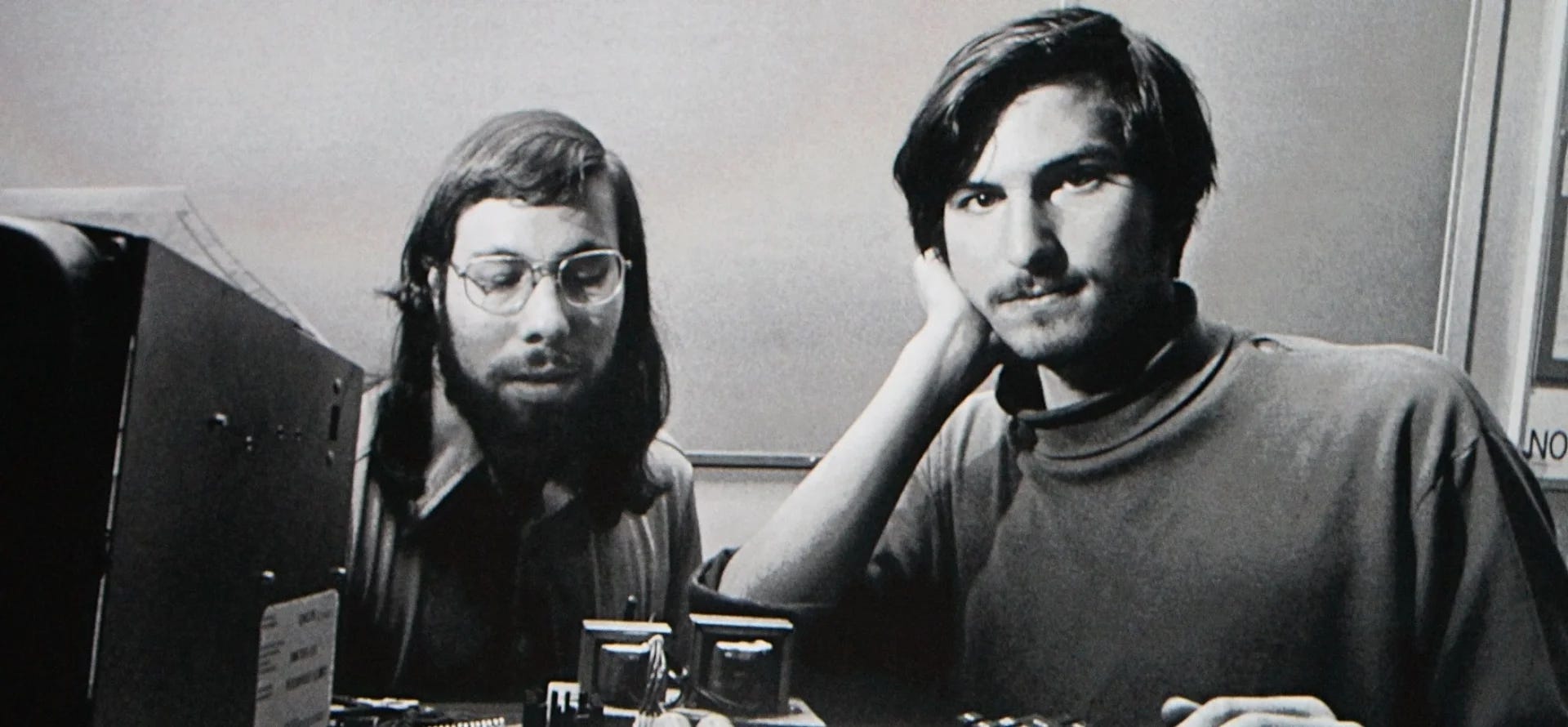
Apple, too, has a garage. Steve Jobs’s Los Altos address, 2066 Crist Drive, is a historic site. Most narratives of Apple’s founding depict Jobs and Steve Wozniak assembling computers inside it. Wozniak has long said the garage is partly a myth: No design work was performed there. Wozniak designed and constructed the Apple I at night in his cubicle at HP and in his Cupertino apartment, then physically transported his completed circuit boards to the garage so they could be tested. At the same time, he claims, the garage “represents us better than anything else.”
Literally, the garage did not house any of the actual work. Figuratively, though, it’s accurate: the garage represents the two young, underfunded, audacious nerds that Jobs and Wozniak were. People kept telling the story of the garage because it justified their faith that a small group could launch a big operation.
Startups need it more than anyone
If you’re an established business, you have revenue and a base of repeat customers – artifacts that go a fair way to provide measurable facts that prove your worth. If you’re an early-stage startup, you have a prototype, and that’s literally your entire story – that’s what will earn you your first meeting, your first hire, your first investor.
Seed investors betting on early-stage companies without revenue, without much of anything at all, are betting on founders – and the origin myth is how you frame your vision, and why you believe you are the right person to act on it.
Put simply, if you haven’t defined your specific myth, you don’t know what you’ll say in your pitch meeting, hiring meeting, fundraising meeting, etc. Founders often delay defining this story because they find it braggy, or the real history is too complex. Story is always complex. You have to pick the parts that will resonate with your audience and repeat them enough to become second nature.
The functions of an origin myth
An origin story has four purposes for founders:
It recruits employees. Early employees make wage and time sacrifices to work at a firm that might not exist the following year. The employment contract spells out salary and equity. The origin story spells out the enterprise’s purpose. If you articulate your origin story to a potential recruit as a concise, focused argument for why your company exists, she will know if she wants to dedicate the next four years to it.
It motivates your customers to share stories about your brand. If you can tell a compelling story, a Podcast-ready story (I know, I know), most people are ready to spill your brand’s story to pretty much anyone. We love sharing stories that make us sound and seem interesting enough to know about them in the first place.
It resolves internal disputes. When a company is split on whether to redesign the product for a single large client, or whether to raise prices, employees are looking for an objective standard that isn’t based on the loudest voice in the room. Knowing the company’s founding story lets them ask, "We got our start trying to solve X for Y, and this decision helps us do that." A founder who does a good job of articulating the origin story makes fewer decisions herself because her employees can make them.
It endures a bad quarter. When a business experiences revenue decline, when a competitor announces a large raise, or when a senior executive quits, employees wonder if they should stick around. If the founder can explain the purpose of the company, employees know why they should stay, independent of the chart for the month.
An origin myth is edited, not fabricated
All businesses are born of a hundred incidents, but a founder’s story should synthesize two or three of them. (Learning to tell a story is learning to edit, as much for your Garage Days as for your memoir.) Think of Nike’s story: Bill Bowerman, an Oregon running coach, had an epiphany one day: he made waffle-soled shoes (using his waffle iron!), and they worked really well! If you weren’t there, you don’t know whether that took an hour or a months-long process; but it’s a concrete image that says everything you need to know about Nike: a coach who tinkers with his runners’ shoes to help them run faster.
If you’ve edited your story so that it reflects the truth of what your company does, you’ve edited well. If people hear the rest of the story later and feel misled, you’ve edited badly. Wozniak’s edit of the Apple story is clearly not harmful, because the garage is a true metaphor: little money, no office, tons of courage.
But inventing a crisis moment, a key moment of innovation, or some easily disproven rags-to-riches fable is another thing entirely.
Journalists will fact-check it.
And then they’ll fact-fuck you.
Ex-employees will say something. When one link of the chain breaks, the whole story will be undermined, along with your company.
How to write your founder’s story
Start with the problem you faced, and give concrete details: place, person, object, obstacle, struggle, survival, etc. The waffle iron of Bowerman, the garage of Hewlett and Packard, the cereal boxes of Airbnb. Concrete details make a story more memorable than abstract ideas.
You’ll get most of the information from just three questions:
What did you notice that no one else saw?
What was your first attempt, and how and why did it fail?
Who was your first customer (or your first fan)?
Keep costs, non-answers, and shoddy early drafts in the story. It’s more truthful to tell a story of loss, and it’ll ring true. And while you’re at it, keep your origin myth under a minute.
If it’s a legend, it’s because you tell it again and again. And for that to work, you must always say the same thing. When you tell your story to a customer for the tenth time, the same way, you have the story. Tell it everywhere. Use it as the first slide of a pitch deck, put it on the About page, present it to new hires, put it in your sales pitch.
Remember: it’s a personal story. You’re there to talk about yourself to customers and employees, not just about the problem. If you don’t play the hero, you’ll bore your audience.
“We raised a seed round from a famous fund” is not an origin story. It’s just a boring-as-all-hell venture story, interesting only to founders. You should talk about the funds raised in a press release, not in the founding story, which has to explain why you started a business in the first place.
Finally: I hate to say it, but this isn’t actually optional.
An origin myth is table stakes.
If you don’t tell your story, if you stay quiet, someone else will tell the story for you, with whatever scraps of your data they can find, and they’ll get a chunk of it wrong: the size of your round, your previous jobs, the rumors about the conflicts between the founders. Then you’ll spend years cleaning up a story that could have been written in an afternoon. You are not above this, you are not too good for this, and you are not a special snowflake whose product is so good it sells itself.
Write your story this week.
Write the story as you would tell it to a friend.
Edit it so it sounds like a one-minute speech.
Say it to an outsider. If you lose their attention, go back to editing.
Then say it to the next ten people who ask you what you do, in the same way, always.
🍕 I’m JA Westenberg. I write essays about technology, philosophy, productivity, and what it means to be human. If you’re an optimist, you’re in the right place. You can read my AI disclosure here
Work with me:
