How to Live Without Options - and Why It's the Key to Happiness
It turns out closing doors is the key to happiness.
Julius Caesar stood on the bank of a shallow river called the Rubicon.
It was 49 BC, and he was out of options.
The Senate, marshalled by his rival Pompey, had ordered him to surrender his command in Gaul and return to Rome as a private citizen, which in practice meant prosecution, ruin, and probably either exile or death. The river was the legal edge of Italy, and Roman law forbade any general from leading an army across it. To cross with his legion was treason - an open declaration of civil war he could never take back.
Plutarch and Suetonius both describe him stalling at the water’s edge, arguing with his officers, weighing the slaughter on one side against the humiliation on the other.
And then the moment came.
He quoted a line from Menander, a Greek playwright he loved, “let the die be cast,” and led the Thirteenth Legion across into Italy.
A few years later he was master of Rome - and by extension, the world.
We still quote that phrase, the die is cast. The crossing was the last moment Caesar could turn back; and he crossed to effectively destroy every alternative. Take away the irreversibility and the crossing is just a man fording a stream.
But Caesar was more than that.
Thousands of years later, “Keep your options open” has become the secular religion of the ambitious.
We give high-achieving young adults the same advice: optimize for flexibility. Take the dual degree. Start a side hustle, because it “leaves more doors open.” Date without labels, rent instead of buy, defer the permanent choice to keep tomorrow open.
We borrowed this instinct from finance - where pricing options under uncertainty has made countless literal fortunes. In markets, optionality has a precise, quantifiable, and strictly positive value: when the future is volatile, the ability to change your mind without penalty is the most valuable asset you can hold.
But apply that logic to personal life, to relationships, careers, community, and identity, and it backfires - every time. Psychological research keeps turning up a stubborn fact: human beings are measurably, predictably less happy with reversible decisions than with irreversible ones. We optimize for the escape hatch, but we keep finding out the escape hatch is the source of our misery.
I. Why Optionality Is Mathematically Correct
A financial option is the right - but not the obligation - to take a specific action in the future. A call option lets you buy an asset at a set price; a put option lets you sell.
An option works through its asymmetric payoff. Hold a call and the stock plummets: your loss is capped at the premium you paid, so you let the option expire. If it soars instead, your gain runs, in theory, without limit. You take all the upside of ownership without bearing its risks.
Real Options Theory
Economists carried the same logic beyond stock tickers and into the physical world. They built Real Options Theory in the 1970s and 80s to bring options pricing to tangible business decisions.
Imagine a mining company deciding whether to build a massive extraction facility. The price of copper swings wildly. Build the mine today, an irreversible commitment, and you risk bankruptcy if copper prices crash. Instead, the company buys the land rights and delays construction. It has bought a real option. If copper booms, it builds. If copper busts, it walks away, losing only the land cost.
Three principles follow from Real Options Theory:
Volatility increases the value of an option (in options pricing, this is Vega). The more chaotic and unpredictable the future, the more valuable the right to wait and see.
Irreversibility destroys option value. The moment the company pours the concrete, it exercises the option. The flexibility is gone, and the company now bears the full downside.
Time is an asset (this is Theta). The longer you have until you must decide, the more time there is for advantageous volatility to occur.
View human life as a chaotic, high-volatility system with incomplete information, and the financial mandate is clear: hoard options, delay every irreversible commitment, and guard your time and capital until the perfect risk-free opportunity arrives.
In a perfectly liquid market full of rational actors betting on exogenous events, this logic is flawless.
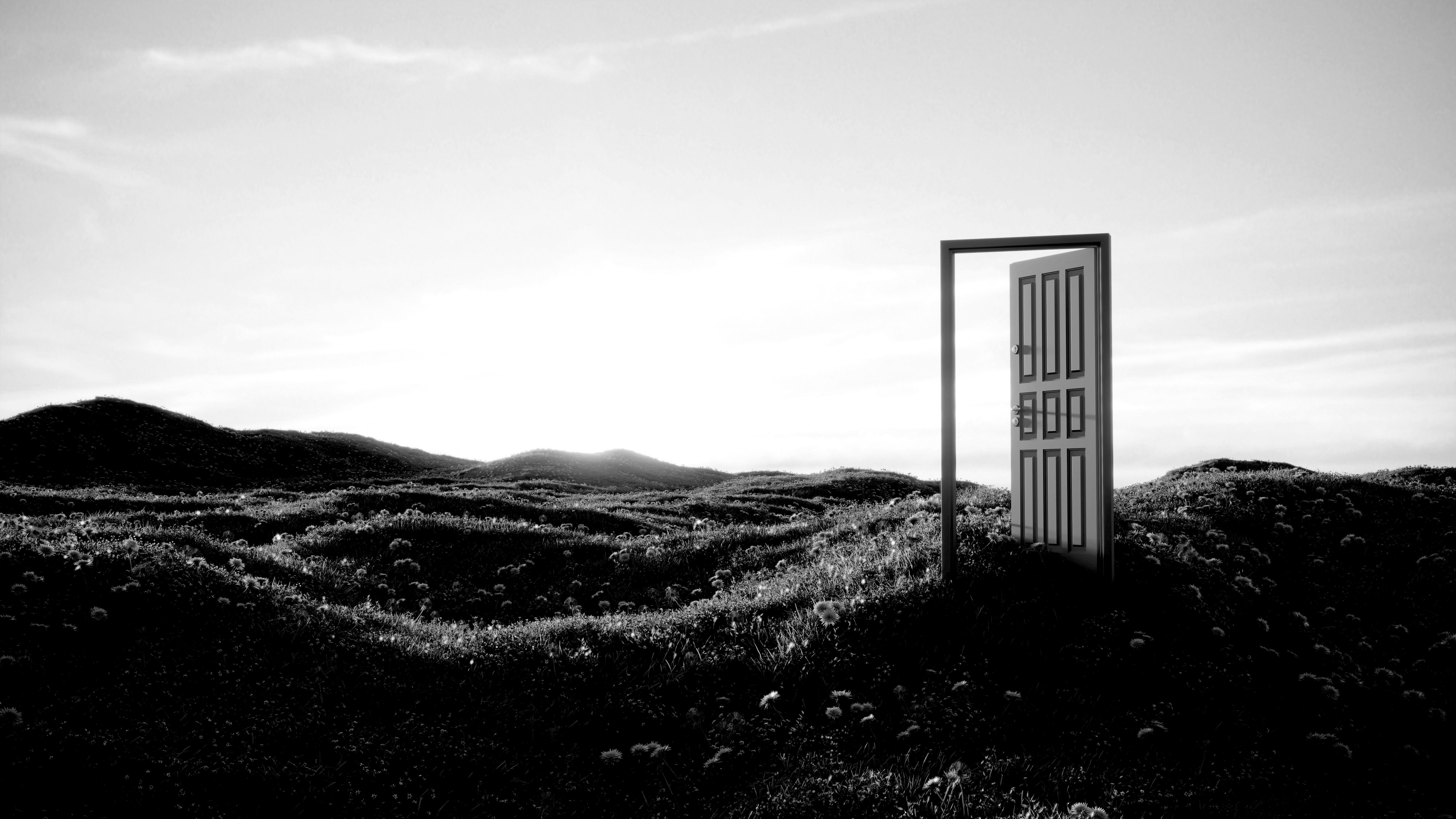
In his 2015 shareholder letter, Jeff Bezos sorted decisions into one-way doors and two-way doors. A one-way door is consequential and nearly irreversible, so you walk through it slowly, with deliberation. A two-way door is reversible, so you move fast and reopen it if you dislike what you find. He warned managers that big organizations start shoving every two-way door through the slow, agonized process meant for one-way doors. But we make the opposite mistake in our private lives, treating one-way doors as though we could always stroll back through them…
II. A Psychological Anomaly
If human beings were purely rational economic agents holding portfolios of life choices, preserving optionality would raise our well-being. But the opposite is actually closer to the truth.
Harvard psychologist Dan Gilbert focuses his work on the “psychological immune system,” the cognitive machinery we use to synthesize happiness and make peace with our circumstances.
Gilbert demonstrated the reversibility paradox directly with a photography class. Researchers set up a black-and-white photography course for university students. Over several weeks the students took photos, learned the darkroom process, and finally picked their two best prints.
The researchers then told each student they could keep only one of the two photos; the other would stay in the archive.
The researchers split the students into two groups:
The irreversible group. The researchers told them the choice was final. Once they handed over the second photo, it would be beyond retrieval.
The reversible group. The researchers gave them optionality: they could take one photo home, but they had up to five days to swap it for the other if they changed their minds.
By financial logic, the reversible group should be strictly better off. They hold the same asset, the photo, plus a free put option, the right to exchange it.
When researchers surveyed the students days and weeks later, the results contradicted the economic model. The irreversible group loved the photograph they chose and kept finding new reasons to admire its composition and lighting.
The reversible group was far less happy. They agonized over the choice and ruminated on the photo they left behind. Even after the five-day swap window closed, they rated their chosen photo lower than the irreversible group did.
Synthetic Happiness
Optionality jams the psychological immune system.
When a decision is permanent, the brain starts rationalizing it beneath awareness, talking up the chosen path and talking down the alternatives. Gilbert calls this synthetic happiness; and functional MRI scans show it registers in the brain exactly like the natural form, the feeling of getting what you originally wanted.
But only irreversibility triggers the psychological immune system; it needs a closed door to switch on.
When a decision stays reversible, the brain keeps recalculating. The background processing monitors the unchosen alternative, asking: Should I exercise my option? Have circumstances changed? Is the other path better now?
In the financial market, that continuous recalculation generates alpha.
In the human mind, it’s anxiety.
In your mind, it’s the inability to commit to a note taking app…
III. Locating the Boundary
Where exactly is the line, given that Real Options Theory is right for mining companies and Dan Gilbert is right for human beings? Why can we price a copper mine as an option but not a marriage, a career, or a move across the country?
The paradox turns on a few assumptions buried in the financial math, assumptions that fall apart inside a human life.
Axis 1: Exogenous vs. Endogenous Risk
In financial markets, you don’t control the underlying asset. Hold an option on Apple stock and your internal emotional state has zero effect on how many iPhones Apple sells next quarter. The risk is exogenous, external to the observer, so sitting back and waiting for more information is a dominant strategy.
In life, most risk is endogenous. You help create it, and your commitment to a path directly changes the odds the path succeeds.
Treat a romantic relationship as a reversible option, keep one foot out the door, leave the dating apps running just in case, and you change the relationship itself. You breed mistrust, shallow talk, and emotional withholding. By hedging against a bad relationship, you guarantee one.
The financial model assumes the asset’s value is independent of your commitment to it. Your commitment, though, is what creates the value.
Axis 2: Liquid vs. Compounding Value
Financial options live in highly liquid markets. You can hold an option on a barrel of oil without knowing the first thing about drilling, and extract value purely through arbitrage.
Human value is illiquid and depends on compounding. You can’t buy mastery of a hard skill, a deep friendship, a sense of community, or a real reputation on any spot market. None of it exists in a liquid state.
These assets accrue only through the sustained, irreversible investment of time and attention.
Hop between entry-level jobs in different industries through your twenties to “maximize your options,” and you optimize for liquidity while failing to compound. A person who irreversibly commits to a single difficult discipline for ten years will eventually generate financial, intellectual, and social returns no option-maximizer ever reaches.
Optionality protects your starting capital.
Only irreversibility lets it compound.
Axis 3: The Static vs. Dynamic Observer
When a quantitative analyst prices a derivative with the Black-Scholes model, the model assumes the analyst will be the same person tomorrow as today. The observer is static.
In personal decisions, the observer is dynamic. Making an irreversible choice rewrites your identity, your preferences, and your values.
Decide to have a child and you aren’t a static observer acquiring a new asset; you’re crossing an event horizon that ends one self and begins another. The person making the decision isn’t the person who will live the outcome.
You can’t rationally calculate the expected value of becoming a parent, because you don’t yet have the cognitive or emotional framework of a parent.
Keeping options open assumes your “true self” is a static entity waiting for the perfect external circumstances to arrive. But identity forms in the furnace of constrained choices. By refusing to commit, you don’t preserve your identity; you arrest its development.
You stay a sketch, refusing the permanence of ink.
Axis 4: Asymmetric Downside vs. Bounded Upside
The appeal of a financial option is a downside capped at zero and an upside left open.
When people apply this to their lives, they fixate on capping the downside. They avoid marriage to dodge a messy divorce, and avoid deep specialization to dodge a dying industry.
For a person, optionality caps the upside too.
You can’t feel the deep upside of a thirty-year marriage while you audit the relationship for an exit. Professional mastery stays out of reach if you pivot the moment the work turns grueling. By shielding yourself from the pain of irreversible failure, you wall yourself off from the peaks of human satisfaction, the ones you reach only through the narrow gate of permanent commitment.
IV. Why We Choose the Corrosive Path
Irreversibility triggers the psychological immune system, compounds value over time, and leads to our deepest satisfaction. Why, then, are we so terrified of it? Why do we fight to keep doors open even as the drafts from those open doors leave us shivering?
1. The Affective Forecasting Error
We’re terrible at predicting our future emotional states. Standing at a crossroads, we look down the path of irreversible commitment and vividly simulate regret.
We picture ourselves stuck in the wrong job or trapped in the wrong city or stuck in a PKM tool the rest of the world finds…well, naff. Because that immune response runs below conscious awareness, we can’t factor it into our forward-looking math. We don’t realize that once we choose, our brains will start synthesizing happiness and re-weighting our preferences to back the decision.
Unable to forecast our own resilience, we overpay for the insurance of optionality.
2. Loss Aversion aka the Ghost Ship
In her essay “The Ghost Ship That Didn’t Carry Us,” Cheryl Strayed writes about the parallel lives we never lived. Every choice murders an infinite number of potential futures.
"I'll never know, and neither will you, of the life you don't choose. We'll only know that whatever that sister life was, it was important and beautiful and not ours. It was the ghost ship that didn't carry us. There's nothing to do but salute it from the shore."
Robert Frost talked about the same grief in 1916. The traveler in “The Road Not Taken” keeps the first road “for another day,” then admits he doubts he’ll ever come back, and braces to recount the choice with a sigh “ages and ages hence.”
Humans are wired for loss aversion; losing $100 hurts about twice as much as gaining $100 feels good. When we make a permanent decision, the loss of every other potential life hits at once and hard. The gain of the chosen life arrives slowly, compounding somewhere off in the future.
Optionality is an anesthetic against the grief of unlived lives. By leaving choices reversible, we pretend we can keep the ghost ships sailing alongside us. We trade a real life for the comfort of potential energy.
3. Options = Cultural Prestige
Wealth, elite education, and youth all buy optionality. A billionaire has more options than a middle-class worker; a 22-year-old has more biological and temporal options than a 70-year-old. Because optionality is a byproduct of high status, we’ve come to treat optionality as the goal of high status.
We signal our worth to peers by showing how many doors stand open to us.
Closing those doors feels like surrendering status.
We confuse the luxury of having choices with the necessity of making them.
4. Hedging Against Identity
Endless optionality lets you dodge self-definition.
To say “I am a software engineer” or “I am a husband” or “I live in Chicago” is to accept limits. It draws a boundary around the self and opens you to specific critiques and specific failures.
Stay in perpetual reversibility, the digital nomad, the serial dater, the eternal student, and you become immune to targeted failure. You can never fail at your life’s work if you never define what your life’s work is. Reversibility is a shield for the fragile ego.
V. When Optionality Is the Right Call
Permanent choices don’t have to be blind or reckless. Over-correct and you land in a reactionary traditionalism that demands 18-year-olds pick a lifelong career and never deviate.
Don’t eliminate optionality; sequence it. Distinguish the exploration phase of life from the exploitation phase, what computer scientists call the multi-armed bandit problem.
The Multi-Armed Bandit
Picture yourself in a casino facing a row of slot machines, multi-armed bandits, each with an unknown and different payout rate. How do you maximize your winnings over a set amount of time?
Pick the first machine and play it exclusively, pure commitment, and you might get stuck with a terrible payout. Spend your whole time pulling every lever once to gather data, pure optionality, and you never sit down to harvest the machine that pays best.
The mathematically optimal strategy is sequential:
Explore wildly early on: gather data, keep options open, try many things with low switching costs.
Exploit ruthlessly later. Once you’ve found the work that fits, the partner who stays, the place you want to live, you abandon optionality and commit. You sit at that machine and pull the lever until the game ends.
Optionality is useful in the first 10 to 20 percent of any domain: finding where your comparative advantages lie etc. The tragedy is when people stretch the exploration phase into the exploitation phase, treating their 30s and 40s as an endless beta test.
Warren Buffett tells students to imagine a punch card with room for only twenty investments in an entire lifetime. Every punch is permanent, so you have to quit dabbling and load up on the few you truly believe in. The card forbids reversal; a scarcity of moves, rather than an abundance of options, forces each to count.
On Courage and Closed Doors
Real Options Theory is a brilliant framework for managing capital, because capital has no feelings, no identity, and no need for meaning. If you run a hedge fund, maximize your options.
But a human life isn’t a portfolio of assets. It’s a single unfolding narrative, and a narrative with no irreversible choices isn’t a story at all; it’s a pile of character concepts and world-building notes that never add up to a plot.
We’re terrified of the very constraints that make us happy.
We misread how our own minds work, assuming freedom means the absence of permanent choices.
Infinite choices cannot - ever - liberate us; they can only paralyze us in a state of perpetual evaluation. Freedom waits on the other side of the irreversible choice; freedom from agonizing over what-ifs; freedom to let the psychological immune system do its slow, healing work; freedom of compounding returns, where the deeper you dig into one patch of earth, the richer the soil becomes.
When Hernán Cortés landed at Veracruz in 1519, he had his ships scuttled, hulls bored through in the dark, so his men woke to a fleet sinking in the bay and understood that no one was sailing home. Legend later promoted the scuttling to a bonfire, because burning the fleet made a better story than boring holes in the hulls. Set aside the conquest and the cruelty: he wrecked his own way home on purpose, and his men had nowhere left to march but inland behind him. It’s where we get the phrase: to burn your boats behind you.
And sooner or later - you must.
To build anything that lasts, a career, a marriage, a coherent self, you have to burn the boats; you have to walk through a door and lock it behind you.


So many great lines, sis. Love that it all rhymes with "Sunk Cost Fallacy Fallacy."
Because I work with novelists all day (many of whom don't want to make the irreversible, irrevocable choices that story requires), this one is my fave: "It’s a single unfolding narrative, and a narrative with no irreversible choices isn’t a story at all; it’s a pile of character concepts and world-building notes that never add up to a plot." Ooof. 💝