
The Line at Agincourt
Why Hierarchical Systems Collapse Under Mud and Rain
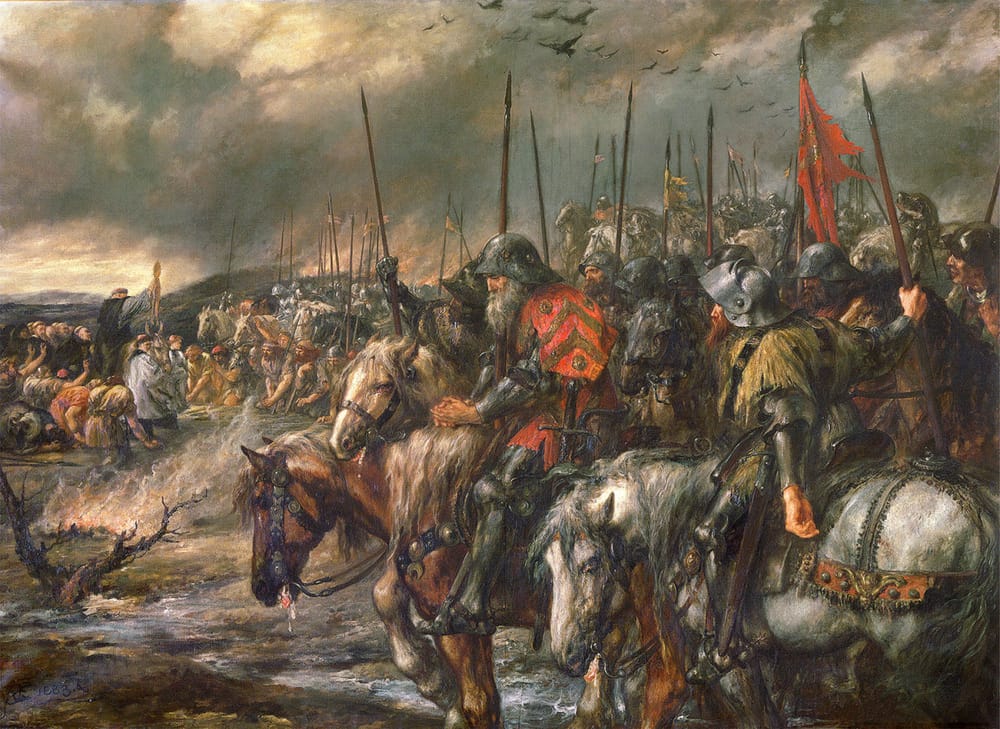
On October 25, 1415, the cream of the French aristocracy stood waiting in their armor. They were arranged in three lines. Behind them: thousands of reinforcements. Before them: an exhausted English army, starving, diseased, and outnumbered at least three to one. This was going to be a slaughter.
It was. But not the one the French expected.
The Battle of Agincourt is one of the most-studied military engagements in history. It wasn't particularly large, or pivotal (not in the long run), but it makes for an elegant case study in the fragility of structured power and how perfect order, under the wrong conditions, becomes the perfect target. Rituals of command are not the same thing as strategy. And hierarchy, when ossified, becomes less a way of organizing action and more a way of distributing delay.
You can still visit the muddy fields in northern France where thousands of French knights drowned in their own armor, stuck in the churned earth, too disciplined to break formation, too proud to yield.
And it doesn't seem like much has changed.
Formality as Folly
The French army at Agincourt was organized, disciplined, and richly equipped. They were also absurdly confident. Chivalry, in its waning years, still clung to the idea that war was a matter of rank and appearance. Nobles rode to battle in heavy plate, led by hereditary commanders who earned their posts through lineage, not learning. The army marched under banners and coats of arms like a medieval fashion show. There was no need for surprise or subterfuge. They assumed they were entitled to victory.
The English didn’t play by the rules.
Henry V arranged his forces in a narrow wedge between two dense woods, forcing the French to attack through a bottleneck. He relied on archers - commoners, largely - who wielded longbows with deadly force. They were lightly armored and quick-footed. They worked in the mud and the dark. They aimed for the horses, the faces, the exposed armpits.
None of this was noble. All of it worked.
When the French charged, they sank. The rain turned the plowed field into a pit. Horses fell. Men drowned under other men. The orderly ranks collapsed into an amorphous crush. The longbowmen fired until their arms gave out. By nightfall, thousands of the French elite were dead. The English had lost fewer than 500 men.
This is what happens when a hierarchy meets entropy.
Bureaucracies March in Plate Armor
Every modern institution that has failed in the past fifty years has done so, in some way, because it moved like the French at Agincourt. Wall Street risk models. Megacorporate strategy teams. Military coalitions. Universities. Tech monopolies.
The problem isn’t that these systems have hierarchies. The problem is that they treat hierarchy as truth, rather than approximation. They assume the smartest idea will come from the most senior person. That experience means competence. That decision-making works best when it flows down a chain of command like water through a pipe.
But hierarchy isn’t fluid. It’s sediment. And when pressure builds, it clogs.
A mid-level software engineer spots a failure mode. They flag it. Their manager logs it. Their director stalls it. The VP ignores it. The system launches. The prediction was right. The failure hits.
And after the fact, the post-mortem reads like a feudal roll call.
The Rituals of Power
One of the more revealing books on Agincourt is Juliet Barker’s meticulously sourced account. In it, she details how many of the French were more focused on staking claim to ransoms and honorifics than on battlefield readiness. They debated which noble would capture which English earl. They squabbled over who had the right to stand in which line. There were more arguments about privilege than planning.
This too is familiar.
In many large institutions, meetings are rituals of status assertion. Proposals are not assessed on their validity but on their provenance. Metrics are chosen not for clarity but for politics. The assumption is: if a system has held this shape for long enough, it must be sound.
But that’s not how entropy works. Decay is not deterred by precedent.
What killed the French army wasn’t bad planning. It was inflexible planning. What kills modern systems is not stupidity. It’s the refusal to absorb disorder until it becomes disaster.
The Tyranny of the Line
There is a recurring visual in both medieval warfare and modern bureaucracy: the line. A formation. A queue. A reporting structure. A prioritization chart. Each is an attempt to impose order. Each becomes brittle the moment it encounters something that doesn’t care.
The French line at Agincourt was beautiful. Clean, hierarchical, symbolically perfect. It also trapped them in mud. It locked them into one modality of movement. They could not retreat without dishonor. They could not adapt without breaking protocol. They could not win, but they could not leave.
The line is not the problem. The problem is treating the line as sacred.
Organizations do the same damned thing. They build structures that make sense at one scale, under one condition, with one set of assumptions. Then they forget those assumptions. The structure calcifies. When reality shifts, they sink.
Agincourt Happens Every Day
A product team launches a new feature nobody asked for, but the VP promised it in a keynote. A city insists on routing all emergency services through a central call center, even when locals could intervene faster. A school district mandates test protocols that teachers know will fail half their students. A disaster agency stockpiles the wrong kind of aid because that’s what the procurement form allows.
None of these are (necessarily) examples of malice. They are examples of hierarchy prioritizing itself over its purpose.
The English won because they were tired, hungry, and had nothing to lose. They fought like insurgents, not nobles. They used terrain, timing, and tactics that would have embarrassed a traditional commander. But they won. Because they weren’t trying to preserve a pattern. They were trying to survive.
Organizations that survive are the ones that accept mud. That hire people who think in diagonals. That encourage tactical mutiny when the map no longer matches the field. That let the longbowmen lead when it’s raining.
If your system can’t tolerate disorder, it won’t tolerate change. If your structure can’t flex, it will fail. If your leadership depends on ritual, the ritual will become your tomb.
In Praise of Mud
There is something very modern about the idea that we can spreadsheet our way out of unpredictability. That if our inputs are clean and our workflows are standardized, then our outcomes will be safe. But unpredictability is not the enemy. It is the condition.
Napoleon said that no battle plan survives contact with the enemy. But the French at Agincourt never even got that far. Their plan died in the field. Under the weight of its own assumptions.
It is tempting, in a system, to look for elegant geometry. For the line that leads cleanly from proposal to approval to deployment to success. But the more beautiful the diagram, the more likely it is to collapse under pressure.
The solution is not anarchy. It is agility. It is accepting that sometimes the right move looks messy, costs status, or comes from the wrong person.
Sometimes the field is mud. Sometimes the arrows fly. And sometimes the best thing you can do is break formation and run sideways.
Or better yet: don’t stand in the line at all.