
The Hacker News tarpit
This newsletter is free to read, and it’ll stay that way. But if you want more - extra posts each month, no sponsored CTAs, access to the community, and a direct line to ask me things - paid subscriptions are $2.50/month. A lot of people have told me it’s worth it.
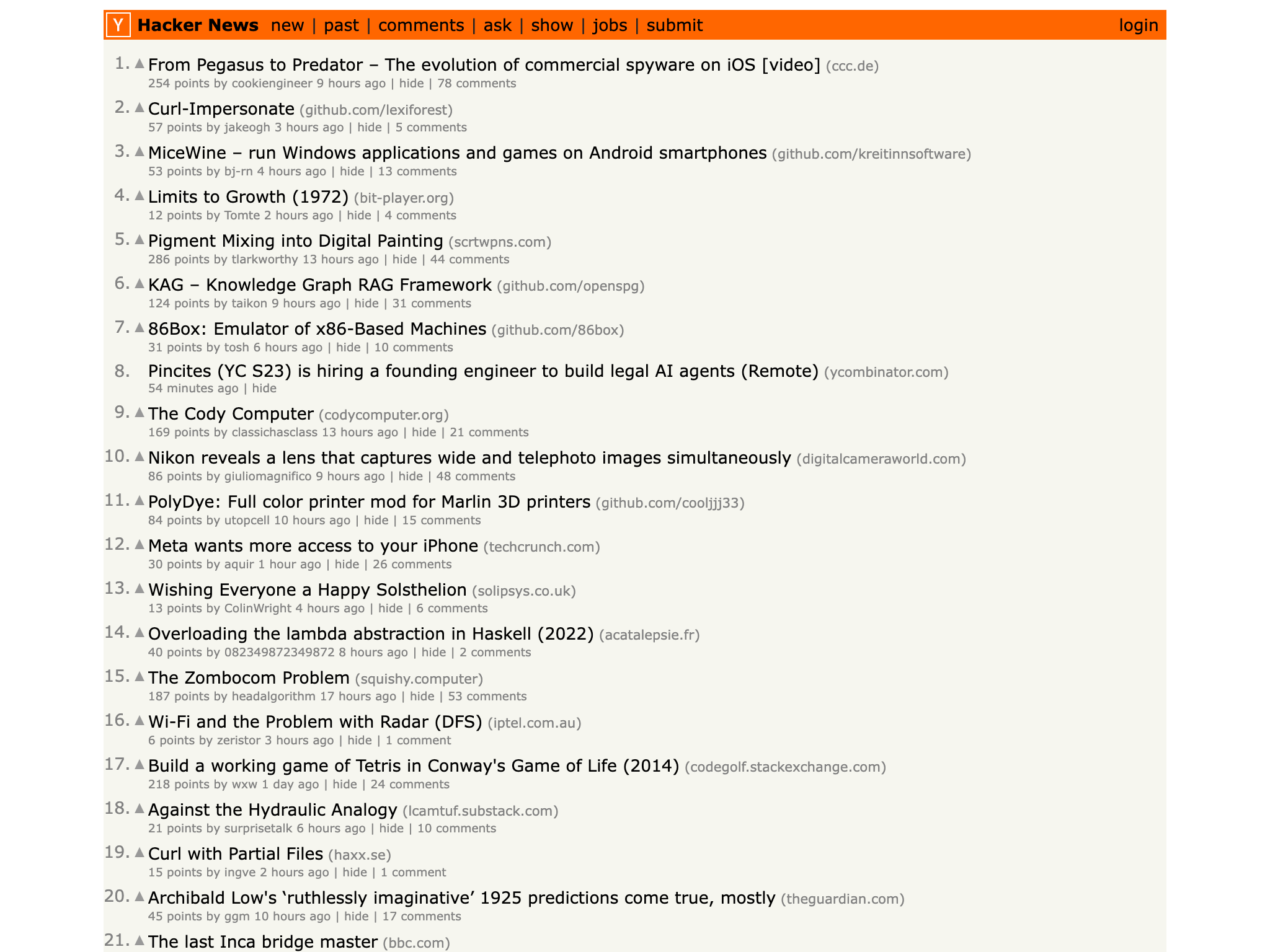
Hacker News is a web application with the following features: a list of links, sorted by votes. Comments under those links, also sorted by votes. User accounts with karma. A text submission option. A jobs board. That's it; that's the entire product.
The database schema would take a handful of tables. You've got users, posts, comments, votes, and some metadata. A first-year CS student could design it. And I don't mean that as an insult to either the first-year CS student or to Hacker News.
Well, I spent a Saturday last month vibe coding a Hacker News clone. Took about 3 hours, most of which was me arguing with the AI about CSS. By the end I had a working link aggregator with voting, comments, user accounts, and a ranking algorithm roughly equivalent to the one HN uses. It looked like Hacker News. It functioned like Hacker News. It sorted stories by a points-over-time decay function and everything.
My 9 year old could have used it.
...but nobody will ever use it.
To be clear - this is not a post about how hard it is to build software. It's a post about how easy it is to build software, and how that easiness fools people into thinking they understand what they're looking at when they see a successful product.
Every developer who sees HN thinks, "I could build that in a weekend." And they're right; they absolutely could. In fact, I'd assume they're pretty shite at their jobs if they couldn't. What they couldn't build in a weekend // month // year // probably ever, is the thing that makes Hacker News actually work. And that ~thing is not the software.
Let me list every Hacker News clone I can think of off the top of my head: Lobsters, Tildes, Barnacles, EchoJS, Hashnode, various subreddits pretending to be link aggregators, that one site called Squishy or Squidgy or something that I remember existing briefly in 2019. Some of these are ok. Lobsters is genuinely good. But none of them are Hacker News in the way that matters, which is: none of them are the place where you go when you want to know what several hundred thousand programmers think is interesting right now.
You can't build Place People Go as a feature. It's a thing that happened over time, through a specific and unrepeatable sequence of events, most of which were not planned and some of which were just luck.
Hacker News launched in 2007 as a side project by Paul Graham, who ran Y Combinator. The initial user base was people who read Paul Graham's essays. Think about what that means for a second. The seed community was a self-selected group of people who were (a) programmers or startup founders, (b) interested enough in ideas to read long essays about programming languages and startup strategy, and (c) already connected to the Y Combinator network.
This is an absurdly good seed community for a tech link aggregator. You could not assemble it on purpose. Or rather, you could assemble something similar, but you would need to already be Paul Graham, which is an unreasonable prerequisite for a product launch.
PG has talked about this a bit. He's said the key to HN's moderation is that they basically hand-tuned the community for years. Daniel Gackle (dang), who has moderated HN since around 2014, reads an almost superhuman volume of comments and applies a consistent but hard-to-formalize set of norms. The guidelines say things like "Be civil" and "Don't be snarky" and "Please don't post shallow dismissals." These rules are not special. Every forum has rules like this. What's special is that someone actually enforces them, every day, across thousands of comments, with at least an attempt at consistency.
A link aggregator is only as good as its community, and the community is only as good as the people in it, and the people are only there because the other people are there. This is a Schelling point problem; everybody needs to coordinate on the same place, and which place they coordinate on is partly arbitrary, and once they've coordinated it is very expensive to move.
There's a bar in your city where all the interesting people go on Thursday nights. The bar is not special. The drinks are mediocre, the lighting is bad, the bathrooms are questionable. But interesting people go there, which makes it interesting, which makes more interesting people go there. If you open an identical bar across the street with better drinks and better bathrooms, nobody is going to switch, because the interesting people are at the other bar. They all know they're at the other bar. There is no mechanism for coordinated switching.
You could build a better Hacker News. Better ranking algorithm, better comment threading, better search, dark mode, an API that doesn't feel like it was designed in 2008 (because it was designed in 2008). None of this matters. The readers, the commenters, the founders who show up for "Show HN" and "Ask HN" and "Who is hiring?" are already at Hacker News. You can't move them by building a nicer website. They are not there because the website is nice.
Vibe coding has made it trivially easy to build software. I can spin up a functional web app in hours. So can most developers. Increasingly, so can people who aren't developers at all. The cost of building the thing has collapsed toward zero.
But most successful software products were never gated by the difficulty of building the thing. They were gated by distribution, network effects, community, trust, brand, regulatory capture, some tangle of these. Making the building part free doesn't touch any of those. It arguably makes them worse, because now you have a thousand competitors who also built the thing over a weekend and are all fighting for the same pool of users who are already using something else.
Imagine you could conjure a fully equipped restaurant out of thin air. Kitchen, dining room, the works. Free. What happens? You don't get a golden age of dining. You get a million empty restaurants, because the scarce resource was never the building. It was the chef who knows what she's doing, the corner spot with foot traffic, the regulars who show up on Tuesdays. Those things take years.
Hacker News is fifteen years of community norms, trust, moderation decisions, accumulated habits, and network effects. You can't build that. It isn't a technical problem. It's closer to an archaeological one. The thing that makes HN work is deposited in layers over time and you cannot speed up the deposition.
There's a lazy version of this argument that says "network effects make incumbents invincible, so never try." I don't buy it. Digg was the Hacker News before Hacker News and it self-destructed. Reddit almost died several times. Twitter did die, sort of, depending on how you score it. These things can break. But they almost always break because the incumbent does something stupid, not because a competitor does something smart.
Digg didn't lose because Reddit was technically superior. Reddit in 2010 was ugly and confusing and had the subreddit system, which I maintain to this day is one of the worst information architecture decisions ever made for a site that size. Digg lost because Digg redesigned itself in a way that enraged its entire user base, at the exact moment Reddit was standing there as an alternative. The coordination problem solved itself because one of the two options eliminated itself.
If you want to replace Hacker News, you don't need a better Hacker News. You need Hacker News to screw up badly enough that people are motivated to leave, and you need to already exist when they start looking for the exit. This is a patience and luck problem, and last I checked neither of those ships with an npm package.
There's a related thing happening all over my Twitter feed. Someone builds a beautiful project management tool over a weekend. They tweet a screen recording. It gets 500 likes. The tool dies off because project management tools don't compete with each other on features. They compete with Jira, and Jira's moat is that your company's entire workflow is caked into it like geological strata. Nobody is migrating away from Jira because some guy's weekend project has nicer fonts.
Same with note-taking apps. Every week there's a new one. Every week it's gorgeous. I have probably tried forty of them since 2015 and I still use a folder of plain text files, because at some point I realized the switching cost isn't money or even time, it's the habits in your fingers, and those are basically impossible to override on purpose. The new app would need to be so much better that it overcomes years of muscle memory, and none of them are, because text files are actually fine.
The demo is not the product. The product is the ugly part that comes after, where you have to convince real people to actually change what they're doing, and that has never been a software problem. I don't think vibe coding makes it any easier. If anything it makes it harder because you have more competition from other people who also demoed something nice and also can't get anyone to switch.
I think the vibe coding discourse has a hole in it, and the hole is shaped like the question: "what is software for?"
If software is a thing you build, then vibe coding changes everything. Anyone can build. We have democratized building. Congratulations to building.
But software is mostly a thing people use, and getting people to use things is not a building problem. It never was. The reason most software fails is not that it was too hard to code. The reason most software fails is that nobody wanted it, or everybody wanted it but was already using something else, or the right people wanted it but couldn't find it, or they found it but didn't trust it, or they trusted it but couldn't get their team to switch.
Hacker News works because Paul Graham had an audience before he had a product, Y Combinator had a network that seeded the community, and dang has been doing the same moderating job every single day for over a decade with what I can only describe as an unreasonable level of dedication. The whole thing has been accumulating social capital for almost twenty years...
I built a Hacker News clone in six hours. To me, it's perfect and for everyone else it's empty and those two facts are going to remain true forever. If that doesn't tell you something about what software is and isn't, I don't know what will.
Westenberg is designed, built and funded by my solo-powered agency, Studio Self. Reach out and work with me: