
The Creator-Monk Path: Solitude, Output, and Building a Life That Doesn’t Scale
Members Only
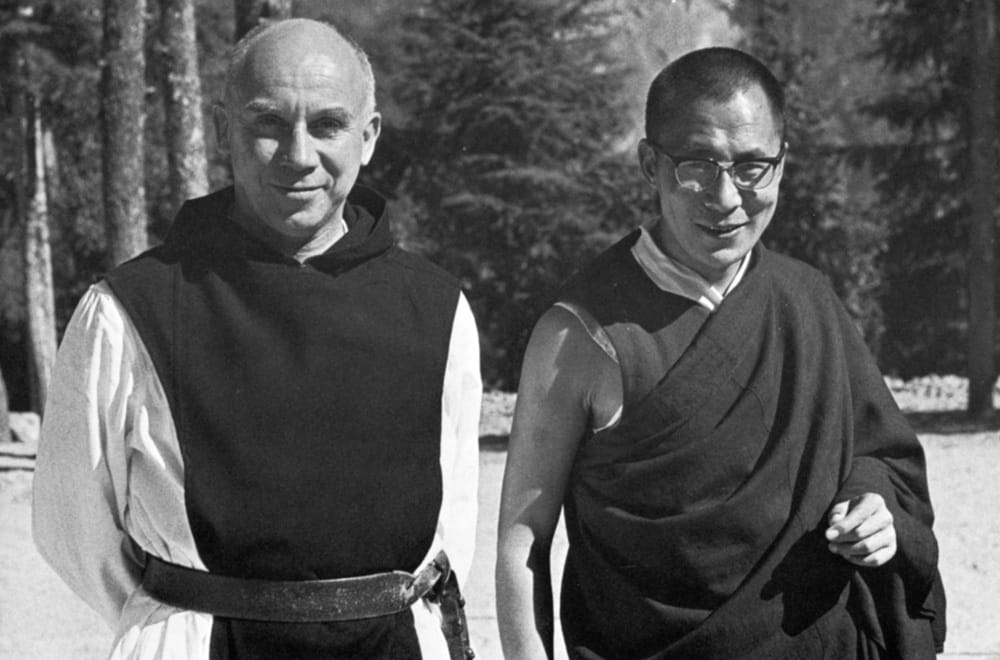
In the middle of the 20th century, the Trappist monk Thomas Merton retreated to a hermitage in the woods of Kentucky to write. He believed silence was necessary for clarity, and clarity was necessary for truth. He refused television, turned down speaking engagements, and gradually reduced his correspondence to almost nothing. His monasticism was not only spiritual. It was also a logistical operating system designed to produce deep, coherent thought.
Around the same time, Norbert Wiener was inventing cybernetics. John von Neumann was building models for self-replicating automata. Claude Shannon was outlining information theory. They saw noise differently: as a feature to be managed, compressed, monetized. The modern information economy was being born while Merton was choosing silence. Each represented a different theory of communication, and (if you’ll allow a little license) a different theory of the self.
The creator-monk path lives somewhere in between. It rejects the maximalism of scale but doesn’t quite retreat from public life. It favors solitude, but with an internet connection. It is not anti-growth. But it is growth-constrained by design, as if the point was to avoid turning a mind into a brand.
The Economics of Not Scaling
I’ve been thinking about this lately, as I refocus and try to lock in on a few things.
There are creators who want to build empires, and there are creators who want to build bodies of work.
And the distinction is clearer than it used to be.
A decade ago, there was less pressure to choose. You could be an essayist with a blog and grow slowly, somewhere between hobby and hustle. Now, to make content is to be immediately, inescapably content-driven. Algorithms do not reward moderation. Audiences do not incentivize restraint.
The creator-monk says: no YouTube funnel, no CRM. No growth hacks. No brand partnerships. They write essays that take three months. They build tools for one hundred users instead of a hundred thousand. They live, intentionally, at the subscale.
This isn’t virtue, necessarily. It’s a sort of architecture.
The costs of scaling are real: you must divide your focus across more channels, more formats, more team members. The cognitive load increases linearly, but the marginal gains plateau. At some point, you stop creating and start managing.
Software startups face the same dilemma. Basecamp’s founders famously turned down VC money and capped headcount. They wanted to stay small on purpose. Not to signal humility, to preserve sovereignty. They understood that the minute you optimize for scale, you subordinate every other variable to it. Product quality, user intimacy, personal time - they all get compressed in the gears.
The creator-monk optimizes for something else: continuity. They want a life that produces output without needing to multiply inputs. A life that does not need to scale to be valid.
The Aesthetic of Withdrawal
There is a risk here. The creator-monk can become performance. You start posting screenshots of your minimalist iPhone. You talk too loudly about not being on Twitter.
The “monk” can become an influencer of austerity.
But posturing aside, there is a deeper instinct: that truth, or craft, or beauty, requires distance. The Romantic poets knew it. So did Emily Dickinson. She wrote nearly 1,800 poems in almost complete seclusion. She published only ten in her lifetime. Her reward was not platform growth. It was fidelity to language.
Withdrawal is not Luddism. It is selective filtration. To build a life that doesn’t scale is to place a higher value on signal than reach. It is to treat attention like a finite substance, not a currency to be mined.
This runs counter to every logic of the current media economy. Creators are told to be everywhere. To repurpose everything. To lean into virality, segment their audience, productize their knowledge. The idea that you would instead slow down, write less, share sparingly - it sounds suicidal. And it is, if the goal is financial maximalism. But if the goal is sustained creation, the trade becomes rational.
Productivity Without Visibility
What happens when output is separated from scale? You get productivity that is neither invisible nor performative. It is not the frantic hustle of the content entrepreneur. But it is not the obscurity of the hobbyist either.
One example is the independent software developer who builds tiny tools. They write in public, often on blogs or forums that predate social media. Their code serves a niche. Their income supports their time. They are not famous, but they are free.
Another is the small newsletter writer who maintains a tight list of 500 paying subscribers. They are not trying to go viral. They are trying to say something difficult, clearly, over time.
These lives are harder to envy because they are harder to see. But that is part of the appeal. They resist the visual grammar of success. They replace it with a standard: consistency, sharpness, alignment between work and worldview.
Living on Your Own Frequency
There is a line in Seneca: If you wish to be loved, love. There is another line, less quoted: Withdraw into yourself, as far as you can - “Quantum potes, intra te ipsum secede.” The Stoics were full of this tension. Engagement vs isolation. Action vs contemplation. A complexity rarely found in Stoic reddit threads.
The creator-monk path resolves it not by changing the unit of measure. It assumes that the highest leverage is not in reach but in depth. That one deeply engaged mind, changed by a piece of work, is more valuable than ten thousand passive impressions.
This is, in some ways, a return to a pre-industrial idea of authorship. Writers wrote for patrons or for God. Musicians composed for a court. The relationship was personal, not programmatic. Distribution was slow, but understanding was durable.
Now, everything is fast. And that speed can be corrosive to judgment. The creator-monk does not fight speed by yelling at it. They simply decline to operate on its frequency.
Tradeoffs, Not Virtues
This path is not morally superior. It’s not necessarily healthier. In fact, it can be isolating, financially risky, even psychologically destabilizing. It is easy to romanticize solitude until it starts to feel like erasure.
But that’s the point. The choice to build a life that doesn’t scale is not a moral claim. It’s a structural tradeoff. You get depth, but you lose reach. You get autonomy, but you forfeit volume. You get clarity, but you lose applause.
Some people shouldn’t take the trade. They thrive in audience-rich environments. They need feedback, fast iteration, the energy of growth. Others find that the cost of exposure is too high. They want the silence of Merton, the precision of Dickinson, the sovereignty of Basecamp.
It is hard to tell which one you are. You only find out by testing the system. And then, by listening to what comes back - not in likes or shares, but in your own output. Are you making what you wanted to make?
The Builder’s Horizon
There is an alternate theory of success. Not blitzscale. Not regrowth Just a long, slow unfolding of competence. One tool, one essay, one idea at a time.
It doesn’t look impressive. It doesn’t sound like a pitch deck. But it works, if your definition of working includes sleeping well, making clear things, and becoming slowly wiser.
It is a humble path. But not a passive one. And in a world where everything is being sucked into the machinery of scale, choosing not to scale is one of the few rebellions that doesn’t require permission.
You just start.
You go quiet.
And you build.