
Sometimes powerful people just do dumb shit
This newsletter is free to read, and it’ll stay that way. But if you want more - extra posts each month, no sponsored CTAs, access to the community, and a direct line to ask me things - paid subscriptions are $2.50/month. A lot of people have told me it’s worth it.
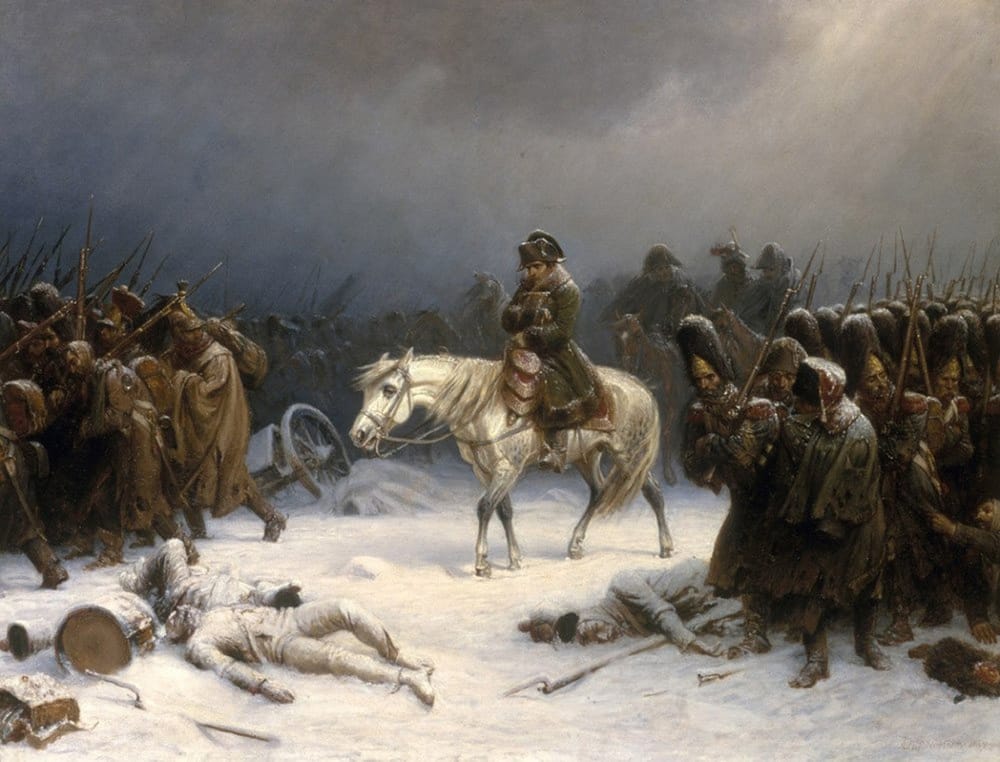
In June 1812, Napoleon Bonaparte marched 685,000 soldiers into Russia - the largest military force ever assembled in European history up to that point, and one of the largest military fuckups of all time.
He had no coherent supply plan for feeding them, he had no realistic timeline for when, exactly, the Russians would agree to fight a decisive battle on his terms, and he couldn’t even articulate a coherent goal for his gamble, beyond ~beat the Russians in some vague way.
He had been warned by multiple advisors, including his own foreign minister Talleyrand, that invading Russia was a catastrophic idea - and he did it anyway.
By December, roughly 400,000 of his soldiers were dead, mostly from starvation and exposure and the consequences of field surgery, and another 100,000 had been captured. The Grande Armée, the most feared fighting force on the continent, clawed its way back across the Niemen River as a frozen, shattered remnant of itself. It was the beginning of the end for Napoleon, who would never again be able to field an army of the size // quality he squandered on his pointless excursion into Russia.
Napoleon was, by any reasonable accounting, a genius - a military mind who rewrote the rules of European warfare, a political operator who fought his way up from being a minor league Corsican nobility to the Emperor of France and ruler of most of modern Europe before he turned 35, and a reformer whose ideas around the judicial system and the liberal order still echo today.
But none of that stopped him from making one of the dumbest decisions any leader has ever made, because he was arrogant, because he’d gotten away with so much for so long that he confused his luck for a system, and because (with the exception of Talleyrand) most of the people around him had simply stopped telling him no.
There’s a particular kind of person who can’t accept that story at face value, and you’ve met them. I am absolutely sure of it. They show up in every comment section and reply thread where someone powerful does something that looks, on its face, like a mistake - and their argument always runs the same way: you don’t understand, this is actually part of a larger plan, there’s a strategy here that you and I can’t see because we’re not operating at that annointed and elevated level…
They’re the 4D chess crowd.
And they are fucking everywhere.
When Elon Musk bought Twitter in October 2022 for $44 billion, a price he himself had tried to back out of after waiving due diligence (a decision so baffling that the presiding judge, Kathleen McCormick, openly marveled at it in court), the 4D chess analysts fired up immediately. You haven’t seen the inside of the honeycomb, they insisted! You don’t get it! You’re not the richest man on earth - how could you possibly hope to process his brilliance?
The mass layoffs that gutted the company’s accessibility team and its content moderation staff were, obviously, equally strategic. The verification fiasco that let someone impersonate Eli Lilly and tank their stock price with a fake tweet about free insulin had to be part of The Plan™️. The advertiser exodus that cratered the company’s revenue was just Musk shaking off the dead weight, building something new, playing a longer game than any of us could understand.
But a jury in 2026 found Musk liable for deliberately misleading investors during the acquisition. People he’d fired had to be re-hired weeks later because nobody had bothered to check whether they were, you know, running anything important before they were shown the door. The company lost roughly 80% of its value under his ownership - because there was no 4D chess. There was simply a billionaire who’d gotten used to being the smartest person in every room he walked into, who didn’t even have a Talleyrand of his own to hint that it might be a bad call, who bought a company on impulse, and then made it worse through a series of decisions that were exactly as bad as they looked from the outside.
The same thing plays out with Trump; every chaotic press conference, every contradictory policy announcement is immediately reframed by his most sycophantic supporters (and, weirdly, by a certain type of opponent who wants to believe they’re up against a mastermind).
“He’s distracting you.”
“He’s controlling the news cycle.”
“He’s flooding the zone.”
“He knows exactly what he’s doing.”
“Wake up, sheeple.”
I’ll grant you - sometimes Trump does know what he’s doing. Sometimes a provocation is calculated and the outrage does serve a purpose. But the 4D chess crowd can’t distinguish between those moments and the moments where the simplest explanation is just that a 79-year-old man with a phone, no impulse control, and an audience of millions is posting whatever dumb shit he feels like posting at 2 AM.
I call it the Hidden Plan Theory.
The powerful don’t get to be powerful without being special, right?
And if they’re special, if they’re smarter than all the rest of us, everything they do must be for a reason, right?
And if we can’t see that reason, that must be a problem with us - mere mortals - not the divinely appointed titans, right?
Right?!
The most recent entry in this genre is OpenAI’s acquisition of TBPN, the daily tech talk show hosted by John Coogan and Jordi Hays. OpenAI reportedly paid in the low hundreds of millions of dollars for a show with 58,000 subscribers on YouTube. The show reports to Chris Lehane, OpenAI’s chief political operative. And predictably, the rationalizers have lined up.
Fortune ran a piece titled “3 reasons OpenAI buying daily tech show TBPN for hundreds of millions isn’t totally crazy.” The argument boiled down to: OpenAI is buying influence, packaging distribution with narrative control, positioning itself to shape public conversation about AI at a moment when that conversation will determine the regulatory environment the company operates in.
And look, some of that might be true.
But it’s worth sitting with the simpler read for a second.
A company whose own executives told staff to stop chasing “side quests” and focus on core AI model development spent hundreds of millions of dollars on a podcast. CNBC’s headline called it “chasing vibes.”
Slate called it “sleazy.”
Ben Thompson at Stratechery did the most thorough demolition job. He compared OpenAI to “the short bus at the end of the rainbow,” which is funny and also brutal and also correct. The whole Stratechery piece is worth reading because Thompson actually bothered to lay out just how incoherent OpenAI’s strategy has become — they were against ads until suddenly ads were the plan, Apple was a partner until they poached Jony Ive, and Anthropic is over there shipping models while Sam Altman is signing checks for a talk show. Thompson’s takeaway: “there just isn’t much evidence that anyone knows what they are doing or that there is any sort of overarching plan.”
And that’s the rub.
The 4D chess read asks you to believe that Altman - Google breathing down his neck, Anthropic breathing down his neck, Meta breathing down his neck - sat down and decided a talk show with fewer subscribers than most mid-tier gaming streamers was the best possible use of hundreds of millions of dollars.
The boring read asks you to believe a CEO did something that served his ego. Pick whichever one requires less of a leap of faith. I know which one I’m going with...
Why do people resist the boring read? Melvin Lerner had a theory. He published a book in 1980 called The Belief in a Just World, and his argument was that most of us walk around with a bone-deep need to believe that people Get What They Deserve. If someone is rich, they must be smart. If they’re smart, their decisions must make sense. And if their decisions look dumb, well, you must be the one who’s missing something. It’s a warm blanket of a worldview. It just doesn’t survive contact with reality.
There’s something else going on, too, and it’s less intellectual // more animal. We see patterns everywhere. We see them when they’re not there. Kahneman built half his career on this - we are so desperate to find signal in the noise that we’ll construct entire narratives out of nothing, and a narrative where the powerful guy is playing 12 moves ahead is just a better story than one where he fucked up because that’s what people do.
But the 4D chess framing also flatters the believer. If you can see the hidden strategy that everyone else is missing, you’re the smart one, you’re the one who gets it. Which rather stops being funny when you realize what it costs…when you insist that every action a powerful person takes is part of a grand strategy, you strip away accountability and you make it impossible to call a bad decision a bad decision.
Every failure becomes a setup for a future success that never arrives, and every scandal a distraction from a larger game that never materializes. The goalposts disappear entirely, because the frame has become unfalsifiable; any outcome can be absorbed into the theory. If the plan works, it was genius. If it doesn’t, the real plan hasn’t been revealed yet.
This is how cults of personality sustain themselves - through interpretation, and through a community of believers who will do the intellectual labor of making sense of the nonsensical, who treat confusion as evidence of their own limited understanding rather than evidence that the thing they’re looking at is, in fact, confused.
The higher someone climbs, the fewer people around them will push back.
The richer they get, the more their bad ideas get funded instead of challenged.
The more successful they become, the more they start to believe that their success came from skill rather than from some volatile, unrepeatable cocktail of skill, timing, luck, and other people’s labor.
Napoleon was brilliant. He was also surrounded, by 1812, by marshals who were tired of arguing with him and a court that had learned it was safer to agree, and the invasion of Russia was precisely what happens when a brilliant person loses the feedback mechanisms that kept them brilliant.
Musk buying Twitter wasn’t 4D chess.
OpenAI buying a podcast for a price that could have funded a mid-sized AI research lab wasn’t a strategic fucking masterstroke.
Sometimes powerful people just do dumb shit, and sometimes there is no plan.
The people who will pay the highest price for the 4D chess delusion are, ironically, the people most devoted to it; because if you can’t look at a powerful person’s decision and say “that was a bloody stupid thing to do,” you can’t learn anything from their mistakes, and you can’t see the world clearly.
But when the choice is between speaking up and watching an unchecked megalomaniac march 685,000 soldiers into a Russian winter without a fur coat in sight, clarity is the only thing worth having.
Westenberg is designed, built and funded by my solo-powered agency, Studio Self. Reach out and work with me: