

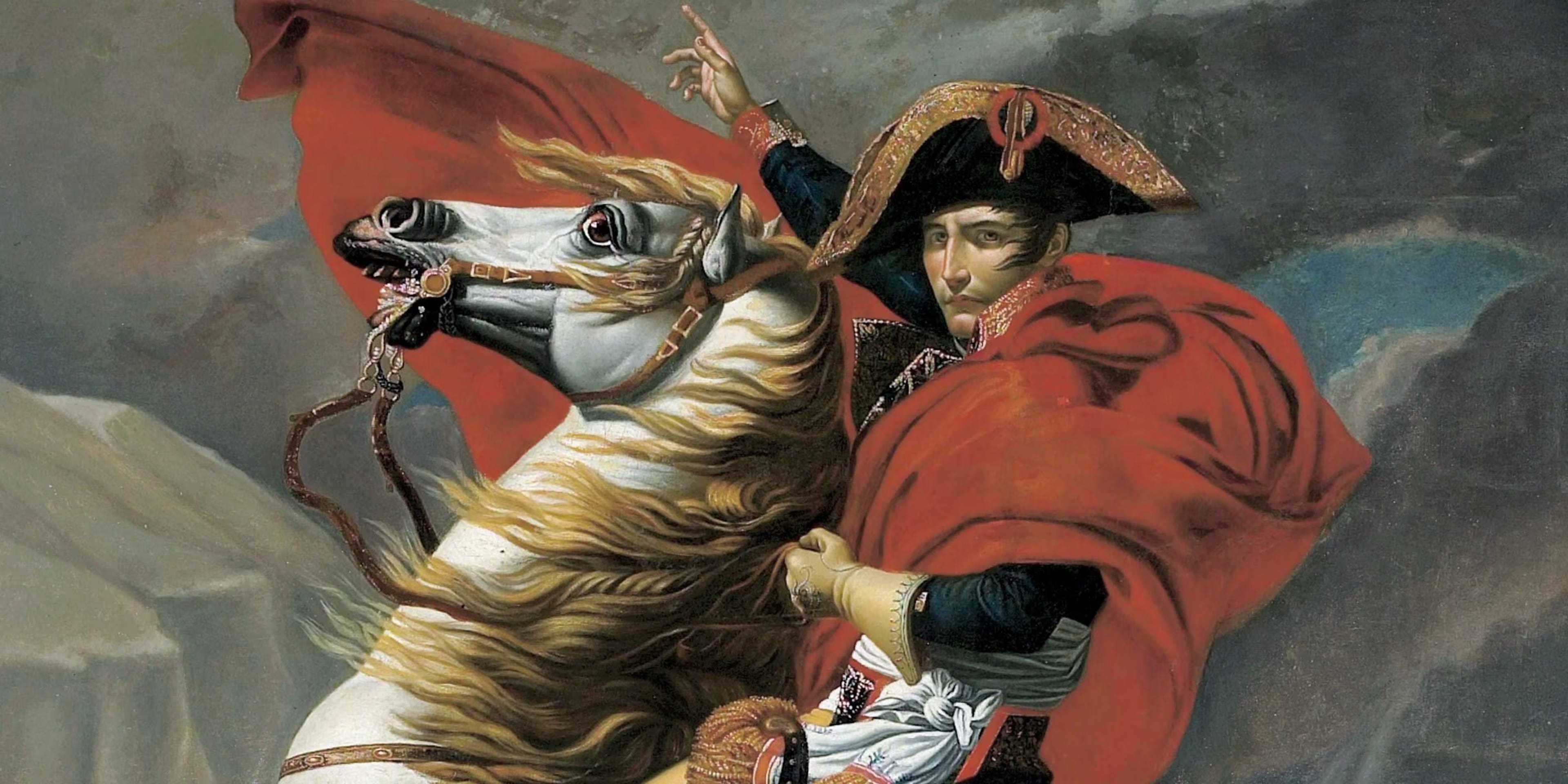
On July 28, 1812, Napoleon Bonaparte rode into the town of Vitebsk and told his staff the war was over for the year.
He had crossed the Niemen River five weeks earlier with the largest army Europe had ever assembled. More than 400,000 men went over in the first wave, drawn from France, Poland, Italy, the German states, Austria, Prussia, and a dozen smaller places that had learned it was unwise to refuse him. The plan was simple, as Napoleon’s plans usually were. Find the Russian army near the border. Destroy it in one decisive battle, the way he had destroyed the Austrians at Austerlitz and the Prussians at Jena. Then dictate terms to Tsar Alexander, who, like every other monarch in Europe, would come to the table and sign.
The Russians declined to cooperate. They retreated. Then they retreated again. They burned crops and emptied villages behind them, and the Grande Armée marched into a country that seemed to dissolve as it advanced. By the time Napoleon reached Vitebsk, his central force had lost something like a third of its strength without fighting a major battle. Men died of dysentery, typhus, and heat. Horses died by the thousands for lack of fodder. Stragglers deserted or were picked off by Cossacks. The supply system, designed for a short war, was already coming apart.
So at Vitebsk, Napoleon did the sensible thing. He announced that the 1812 campaign was finished. The army would rest, rebuild its supply lines, gather its stragglers, and resume in the spring. Maps were unrolled and winter quarters discussed.
He stayed about two weeks. The Comte de Ségur and Armand de Caulaincourt, both of whom later wrote memoirs, describe a man who could not sit still. He paced. He asked what Paris would say. He asked what Vienna and Berlin would say. He brooded on what it would mean for the master of Europe to spend a winter in a provincial Russian town having accomplished nothing. Every argument for stopping was an argument about logistics, and every argument for continuing was an argument about who he was. In mid-August he marched on Smolensk, and when Smolensk failed to deliver the decisive victory he wanted, he marched on Moscow.
Borodino, on September 7th, was the bloodiest single day of the Napoleonic Wars. Somewhere around 70,000 men were killed or wounded between the two armies, and the result was inconclusive. The Russians withdrew in good order. A week later Napoleon entered Moscow and found it nearly empty. That night the fires started and burned for days; when they were done, much of the city was ash.
Napoleon sat in the Kremlin for five weeks waiting for Alexander to answer his peace overtures. Alexander never did. Every day he stayed made the road home longer and the weather worse.
He left on October 19th. The first heavy snow fell in early November. The retreat that followed is one of the great catastrophes in military history: men freezing to death by the hundreds each night, horses butchered for meat where they fell, cannon abandoned in the mud, the desperate crossing of the Berezina in late November with pontoon engineers standing chest-deep in water full of ice. On December 5th, Napoleon left the army behind and raced for Paris in a sled. Passing through Warsaw, he told the Abbé de Pradt that from the sublime to the ridiculous there is but one step.
In 1869, a retired French civil engineer named Charles Joseph Minard drew a chart of the campaign. A thick tan band runs east across the page, from the Niemen toward Moscow, its width proportional to the army’s size. At the start it represents 422,000 men. The band narrows with every mile. A thin black line comes back the other way, tracking the temperature along the bottom as it falls. When the black line finally crosses the Niemen again, it represents 10,000.
Napoleon didn’t lose that army for lack of talent, or information, or warning. Caulaincourt, who had served as his ambassador in St. Petersburg, spent hours in 1811 trying to talk him out of the invasion. He told Napoleon that Alexander would not negotiate on a French timetable. He said the Russians would trade space for time. He described the winter. Napoleon listened, argued, and dismissed it.
He had an answer for every objection, but he never seriously asked whether he should go at all, and he didn’t ask it at Vitebsk either.
We’re no better at asking it of our own commitments:
How do we decide what not to do?
The Asymmetry
Starting something feels like a choice; but continuing it doesn’t. Napoleon decided to cross the Niemen; he deliberated, he planned, he weighed it against alternatives. But he never really decided to march to Moscow that way. Each step east justified the one before it. Smolensk because Vitebsk had been inconclusive. Borodino because Smolensk had been inconclusive. Moscow because Borodino had been inconclusive. Waiting in Moscow because he was already in Moscow. By the end, the campaign was making his decisions for him.
We make the same error.
We take on a project, a client, a role, a commitment, a habit, and then we keep it, and at no point does keeping it feel like a decision. We rarely ruin ourselves through one bad yes. We ruin ourselves through a long accumulation of yeses and an inability to produce the single no that would end them.
Part of the problem is visibility. A yes produces something you can point to: a product, a book, a meeting, a campaign, a building. A no produces nothing. It produces a blank space where a thing might have been. Historians write about battles, and almost never about battles that were wisely avoided. The general who fights and wins gets a statue. The general who declines a fight he would have lost gets nothing, or worse, gets called a coward by people who will never know what he spared them.
Identity is the other problem. Napoleon at Vitebsk was being asked to act against his own story. His entire legend was built on audacity, on doing what other generals considered impossible, on moving faster and striking harder than anyone thought he could. Stopping at Vitebsk would have been strategically correct and narratively unbearable. He’d have had to become, for one winter, a different kind of person, and he couldn’t.
Blaise Pascal wrote in the 1650s that all the unhappiness of men arises from one single fact: that they cannot stay quietly in their own chamber. Napoleon could not stay quietly in Vitebsk. Neither can anyone who has said yes to something because saying no would mean sitting still with the consequences of their own priorities.
Deciding what not to do is hard because doing is the default. Inaction requires a decision; action only requires momentum. If you want to stop, you have to choose it, defend it, and live with the empty space it leaves.
Fili
The same year Napoleon failed to stop, a Russian general chose to abandon Moscow.
In mid-September 1812, a week after Borodino, the Russian high command gathered in a peasant’s cottage in the village of Fili, a few miles west of Moscow. The question before them was whether to fight another battle to save the city. Most of the generals wanted to. Moscow was the old capital and the holy city. Abandoning it without a fight seemed unthinkable, a humiliation so complete that the army might not survive it morally even if it survived physically.
Mikhail Kutuzov listened. He was sixty-seven, heavy, slow-moving, one eye ruined decades earlier by a Turkish bullet. Many of the younger officers thought he was past it. When the arguments ended, he ordered a withdrawal through Moscow and beyond. He reasoned that as long as the army existed, Russia was not lost, and that if the army was destroyed defending Moscow, Russia would lose both.
In War and Peace, Tolstoy has the whole council observed from the top of the stove by a six-year-old peasant girl named Malasha, the granddaughter of the cottage’s owner, who doesn’t understand a word of the strategy but understands perfectly that there’s a quarrel going on between the kindly old man and the general who keeps arguing with him. She takes the old man’s side. Tolstoy, who distrusted grand theories of history and the men who believed they controlled it, sides with her.
Throughout the novel, Tolstoy’s Kutuzov is a figure of strategic restraint. He dozes through councils of war. He declines to issue elaborate plans. He resists pressure from the court, from his own officers, and eventually from the Tsar himself, to attack the retreating French and finish them in a glorious battle. He understands that the French army is destroying itself and that the best thing Russia can do is let it. Tolstoy gives him a line about the two strongest warriors being patience and time.
Kutuzov paid for this in reputation. Moscow’s governor, Count Rostopchin, loathed him. Alexander, who distrusted him, had appointed him only under pressure. Officers grumbled that he was senile, lazy, or afraid. He was none of those things. He had simply worked out what he was for: preserving the Russian army until the Russian winter could finish what the Russian roads had started, and he refused anything that didn’t serve that purpose, however glorious it looked.
Two thousand years earlier, Rome faced the same problem.
They faced Hannibal.
In 217 BC, after Hannibal had crossed the Alps and annihilated two Roman armies, at the Trebia and then at Lake Trasimene, the Senate appointed Quintus Fabius Maximus as dictator. Fabius looked at Hannibal’s record and concluded that Rome could not beat him in open battle. So he refused to fight one. He shadowed the Carthaginian army, kept to high ground, harassed its foragers, and let it wander Italy burning farms while Rome kept its legions intact.
The Romans hated it. They mocked Fabius as Cunctator, the Delayer. His own second-in-command, Minucius, openly criticized him and was eventually given equal command by a frustrated public. Minucius promptly got himself trapped by Hannibal and had to be rescued by Fabius. The following year, Rome ran out of patience altogether. It elected consuls who promised action, raised the largest army in its history, and marched it out to meet Hannibal at Cannae.
In a single August afternoon in 216 BC, something like 50,000 Romans were killed, possibly more. It remains one of the bloodiest single days of battle in recorded history.
Afterward, Rome went back to the Fabian strategy, and over the next decade and a half, it worked. Hannibal won battles and lost the war. The poet Ennius wrote that one man, by delaying, had restored the state, and Cunctator became an honorific.
Delay can be ruinous too. But refusing takes a courage that gets no applause in the moment and often gets contempt. The person who decides what not to do has to be willing to look weak, slow, or afraid for as long as it takes to be proven right, and to accept that they may never be.
Hadrian’s Wall
If refusal in war is hard, refusal after victory is harder.
When the emperor Trajan died in AD 117, he had pushed Rome to the greatest territorial extent it would ever reach. His armies had taken Dacia, Armenia, and Mesopotamia down to the Persian Gulf. Trajan was celebrated as the best of emperors, Optimus Princeps, and his conquests were celebrated with him. Trajan’s Column still stands in Rome, his victories carved in a spiral up its shaft.
His successor, Hadrian, looked at the eastern conquests and gave most of them back.
Rome’s senatorial class hated him for it. Hadrian was abandoning territory won with Roman blood, and he was a beloved emperor. To his critics, he was throwing away glory. But Hadrian had looked at a map and done the arithmetic. The new provinces were in revolt, expensive to hold, and exposed to Parthia. They stretched the army thin along a frontier it could not defend. Holding them would have meant decades of bleeding for land that weakened Rome.
Hadrian wasn’t inventing a new philosophy. Augustus, the first emperor, had left advice, recorded by Tacitus, that the empire should be kept within its existing boundaries. Hadrian took it seriously. He spent much of his reign traveling the frontiers and fortifying them. In Britain, around 122, he ordered the construction of a wall across the island’s narrow neck, seventy-odd miles of stone marking where Roman territory ended.
Imperial monuments usually celebrate expansion; Hadrian’s Wall marks a decision to stop. And the empire Hadrian left was more stable, more defensible, and more durable than the one he inherited.
The person who decides what not to do usually has to give up something that someone else has already celebrated. Very often that someone else is your past self. You were proud of that client, that product line, that ambitious plan. People congratulated you. Walking away means admitting the thing you celebrated was a mistake, or at least that it’s no longer worth the cost of holding on.
This is exactly what Napoleon couldn’t do at Vitebsk. Stopping would have meant admitting the whole invasion was premised on a fantasy: that Alexander would behave the way Napoleon needed him to. Moving forward let him postpone that admission.
How to Decide
Know the one thing you’re for
The Greek poet Archilochus wrote that the fox knows many things, but the hedgehog knows one big thing.
You can’t decide what not to do until you know what you’re doing it for. Without a clear purpose, every opportunity looks roughly as good as every other, and there’s no principled way to turn any of them down.
Look at Napoleon’s objective. The invasion was supposed to force Alexander back into the Continental System, Napoleon’s blockade of British trade. Did marching to Moscow serve it? Only if Alexander behaved exactly as Napoleon assumed he would. Somewhere between the Niemen and Vitebsk, the goal had quietly changed. It was no longer “bring Russia back into the blockade.” It had become “win decisively,” which is a goal about the self. Once your purpose becomes your image, you lose the ability to refuse anything that might threaten it.
Kutuzov, by contrast, knew his one big thing: keep the army alive. Everything else, including Moscow, was negotiable.
Henry David Thoreau, who spent two years and two months in a cabin by Walden Pond trying to work out what was essential, wrote that a man is rich in proportion to the number of things which he can afford to let alone. You can afford to let things alone only when you know what you’re holding onto instead.
Write a single sentence: This year, I am trying to ______. Make it specific enough to rule things out. Then, when a request, idea, or opportunity arrives, hold it against the sentence. If it doesn’t serve the sentence, the default answer is no. Nearly everything will fail the test, which is what the sentence is for.
Price everything in life, not money
Seneca, writing to his friend Paulinus in the first century, noted that people guard their property fiercely; nobody would let a stranger walk in and take their land. Yet they let others walk in and occupy their lives without a second thought. They are tight-fisted with money and wildly generous with time, which is the one thing it would be honorable to be greedy about.
Every yes is a withdrawal from a fixed account. We notice the money cost of a commitment easily and the life cost hardly at all. A project that pays well but consumes three months is not free just because the invoice clears. It costs three months, and those three months could have been used elsewhere.
The trap is comparing the request against nothing. “Should I do this?” invites the answer “Why not?” because the alternative seems to be empty time. But time is never empty. The real comparison is between this thing and the thing you will be too tired, too busy, or too distracted to do because of it. The casualty is usually the work with no deadline: the book, the deep project, the relationship, the idea that needs slow attention.
So convert every request into hours and weeks, then ask what those hours would otherwise go toward. If the honest answer is “my real work,” the request needs to be very good indeed.
Decide before the sirens sing
In the twelfth book of the Odyssey, the sorceress Circe warns Odysseus about the Sirens, whose song lures every passing sailor to his death on their island. She tells him how to get past. His crew will stop their ears with wax. If he wants to hear the song himself, they must bind him to the mast; if he begs to be released, they must tie him tighter.
It works exactly as Circe said it would. The song is overwhelming. Odysseus strains against the ropes and signals to his men to free him. They bind him tighter and row on.
Odysseus knew that his future self, in the moment of temptation, would be compromised. He would want things his calm self knew were fatal. So he decided in advance, while he was still thinking clearly, and arranged things so his compromised self couldn’t override it.
Napoleon at Vitebsk was a man without a mast. He had decided to stop. But the decision was a mood, and moods change. Two weeks of restlessness and wounded pride were enough to undo it, because nothing held it in place.
Before you begin something, decide what conditions will make you stop. “If this hasn’t produced X by date Y, I’m out.” Write it down. Tell someone. Give them permission to hold you to it. Mountaineers set a turnaround time, the hour at which they head down whether or not they’ve reached the summit, because the descent is where people die. The 1996 disaster on Everest, which killed eight climbers in a single storm, is partly a story about turnaround times that were set and then not kept.
A stopping rule feels unnecessary at the start, when you’re full of enthusiasm and clarity. That’s exactly when you need to set it. By the time you need it, you’ll no longer be the person who can be trusted to make the call.
Apply the Vitebsk test
Ask: If I weren’t already doing this, would I start it today?
At Vitebsk, the right question was something like: knowing what I know now, with my supply lines failing, the enemy retreating, a third of my army gone, and winter four months away, would I begin a march on Moscow from this town? The answer is obviously no.
But that isn’t the question Napoleon asked. He asked a different one: having come this far, can I afford to stop? And that question, phrased that way, almost always produces the wrong answer, because it treats everything already spent as a reason to keep spending.
The five weeks Napoleon spent waiting in Moscow are sunk cost in its purest historical form. Every day he stayed was justified by the enormous cost of getting there. Leaving meant admitting that the cost had bought nothing. Staying postponed that admission and made the eventual reckoning far worse.
The Vitebsk test works on everything. Run it on your calendar, your clients, your projects, your recurring commitments, your obligations, your habits. For each one, ask whether you’d sign up for it today if it were offered fresh. Anything that fails is a candidate for ending. Not everything that fails can end immediately; some commitments must be honored or wound down with care. But the ones that fail should go first as each comes up for renewal.
Learn to tell refusal from evasion
Refusal has its own catastrophes, and history punishes them just as hard.
In the third canto of the Inferno, before Dante even crosses into Hell proper, he passes through a kind of vestibule crowded with souls who are neither damned nor saved. These are the people who lived without infamy and without praise, who never committed to anything, and who are now rejected by both Heaven and Hell. Dante reserves a special contempt for them. Among them, he recognizes the shade of the one who, out of cowardice, made the great refusal. Commentators have usually identified this figure as Pope Celestine V, a hermit elected pope in 1294 who found the job overwhelming and resigned after five months. Dante saw the abdication as a failure of nerve with disastrous consequences.
Hannibal is the other side of the Fabius story. After Cannae, with Rome’s army destroyed and the city apparently defenseless, Hannibal’s cavalry commander Maharbal urged him to march on Rome immediately. Hannibal declined. According to Livy, Maharbal told him that he knew how to win a victory but not how to use one. Some people lose because they push too far. Others lose because, at the decisive moment, they stop.
So how do you tell strategic refusal from evasion?
Ask what the refusal protects. Kutuzov’s refusal at Fili protected the army, on which everything depended. Fabius’s refusal protected Rome’s ability to keep fighting. Hadrian’s refusal protected the frontier. In each case, saying no to one thing kept the central purpose alive.
A refusal that protects your central purpose is strategy. A refusal that only protects your comfort is evasion. The two can look identical from the outside, and often they feel identical from the inside too, which is what makes them dangerous. So ask yourself honestly: am I turning this down because it would cost me the thing I’m for, or because it would cost me some discomfort, exposure, or risk of failure? If it’s the latter, the refusal is probably cowardice.
A second test: ask whether the refusal sheds responsibility or takes it on. Celestine’s resignation, in Dante’s telling, shed it. Kutuzov’s withdrawal took on a responsibility few of his peers could have borne, since he alone would answer for the loss of Moscow.
When you say no, say it completely
In 1853, Herman Melville published a story about a Wall Street law-copyist named Bartleby. Bartleby is a model employee for a while, and then one day, when asked to proofread a document, he replies, mildly, that he would prefer not to. He goes on preferring not to. He prefers not to copy, not to leave the office, not to explain himself, not to do anything at all. The story is funny and deeply unsettling, and it ends with Bartleby dead in the Tombs, the New York prison, having preferred not to eat.
Bartleby’s refusals hold because they’re total. His employer tries everything: reasoning, bribery, pleading, eventually moving his entire office to get away from him. Nothing works, because Bartleby’s no is complete.
Our refusals rarely are. We say “maybe later,” “let me think about it,” “I’ll try to fit it in,” “circle back next quarter.” These half-refusals feel kinder, and they let us avoid disappointing someone in the moment. But they keep the commitment alive as a low-grade drain. You keep thinking about it, you feel faintly guilty about it, and very often it turns into a yes you never meant to give.
Emily Dickinson, who spent her adult life refusing the world on her own terms, wrote a poem around 1862 that begins:
The Soul selects her own Society — Then — shuts the Door —
Choosing is only half the act; in the second line, the soul closes the door without apology. Later in the poem, she closes the valves of her attention like stone.
A clean no is almost always kinder than a lingering maybe, both to the other person and to yourself. It doesn’t need a long explanation. One sentence is enough: I can’t take this on. The less you justify it, the less room there is to argue, and the more clearly the door closes.
Subtract on a schedule
Decisions about what not to do usually happen in the moment, when a new request arrives. But the bigger gains come from subtraction: going back over what you already do and removing what no longer belongs.
Michelangelo is said to have carved David by removing everything that wasn’t David. Antoine de Saint-Exupéry, the aviator and author, wrote that a design is finished when nothing more can be removed, rather than when nothing more can be added.
Schedule subtraction the way you’d schedule anything else. Once a quarter, run the Vitebsk test on everything you’re carrying. Pick at least one thing to end for good. If you don’t schedule it, it won’t happen, because the default is always to continue.
The Declined Crown
On December 23rd, 1783, George Washington walked into the Maryland State House in Annapolis, where the Continental Congress was sitting, and resigned his commission as commander-in-chief of the Continental Army. He had won the war. The army was loyal to him personally, more loyal to him than to the weak and broke Congress. Officers had grumbled about Congress’s failure to pay them, and some had floated the idea that Washington should take power himself. He could almost certainly have done it.
Instead he read a short statement, handed back his commission, and went home to Mount Vernon.
When King George III asked the American-born painter Benjamin West what Washington would do after the war, West said he would return to his farm. The king reportedly replied that if he did that, he would be the greatest man in the world. Across Europe, Washington was compared to Cincinnatus, the Roman who was called from his plow to save the republic as dictator, did it, and went back to his plow. Thirteen years later, Washington declined to seek a third term as president, and in doing so set a precedent that held for nearly a century and a half.
In 1804, Napoleon took the crown from the Pope’s hands at Notre-Dame and put it on his own head.
Napoleon could do almost anything. He could reorganize a legal system, redraw national borders, move an army across a continent faster than anyone believed possible. The one thing he could not do was stop, and every other capacity he had depended on that one.
Washington’s power came from what he was willing not to do, and no one could take it from him. Napoleon’s empire was dismantled, and his armies destroyed. No coalition could strip a man of his ability to refuse.
The Thin Black Line
In exile on St. Helena, Napoleon spent years talking to anyone who would listen about what had gone wrong. He is reported to have said that he ought to have died at Moscow, that if he had, he would have left behind the greatest reputation in history. Even at the end, he was thinking about the story. He could imagine a better ending for himself; he still couldn’t imagine one in which he simply stopped at Vitebsk and went home in the spring with his army intact and his story slightly less grand.
On Minard’s chart, the thick band going east is all the decisions Napoleon made by not making them. Each mile is a moment where stopping was possible and continuing was easier. The thin black line coming back shows what those decisions cost.
You will probably never stand at the head of an army, but you have your own Vitebsk: the point in some project, some job, some commitment, some ambition, where the evidence says stop, and the story says keep going.
Deciding what not to do comes down to recognizing that moment when it arrives.
Nobody builds a column for the battle you didn’t fight. Nobody writes the history of the project you declined, the client you turned away, the commitment you ended before it ended you. The empty space where those things would have been is invisible, and the work you care about depends on it.
Kutuzov gave up Moscow to keep that space. Fabius gave up his reputation, Hadrian gave up Trajan’s provinces, and Washington gave up a crown.
Napoleon held Vitebsk for two weeks in the summer of 1812.
And then, tragically, inexorably, inevitably - he marched east.
🍕 I’m JA Westenberg. I write essays about technology, philosophy, productivity, and what it means to be human. If you like ideas that take their time, you’re in the right place. You can read my AI disclosure here.
A reminder: if you sign up as a paid annual member, you get a free digital copy of my book Unsanctioned.
If you become a paid Founding member, you also get:
A digital copy of my book Permissionless
One free year of Post Through It
One free year of Kerouac
Upgrade your subscription, claim your perks, and support independent work for the long haul.