On wintering.
The winterer is out of the loop; they're not maintaining a position because they don't have a position to maintain. They can do work that takes longer than a quarter, longer than a year, longer than 5 years, because nobody is auditing the line item.
This newsletter is free to read, and it’ll stay that way. But if you want more - extra posts each month, no sponsored CTAs, access to the community, and a direct line to ask me things - paid subscriptions are $2.50/month. A lot of people have told me it’s worth it.
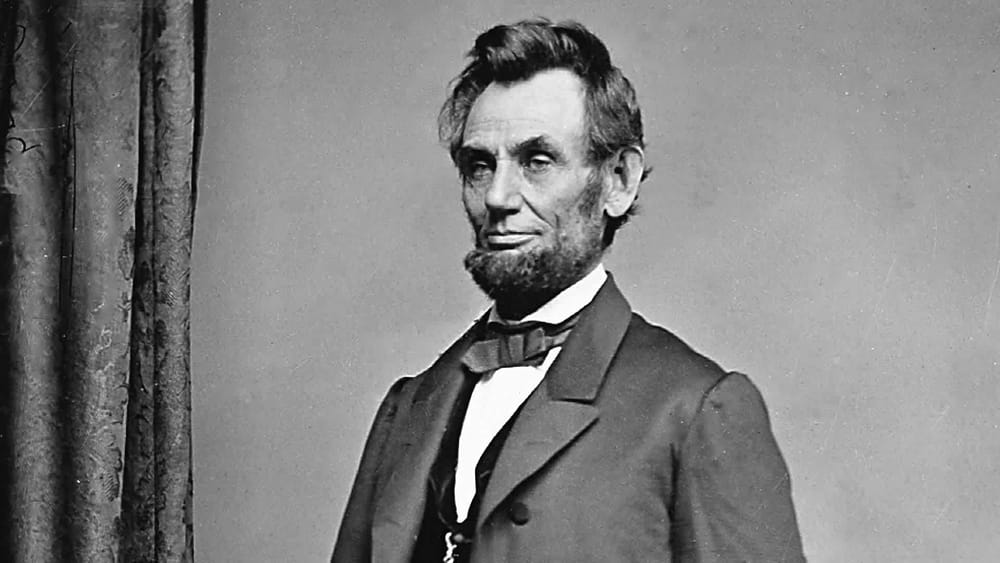
Abraham Lincoln rode home from Washington in December 1849, with what looked like the end of his career packed into his luggage. He'd served one term in the House, alienated his constituents by opposing the Mexican War, and lost his shot at a federal Land Office appointment.
He went back to Springfield to practice law, a near-broken man. And, for nearly 5 years, he barely participated in national politics.
He rode the Illinois circuit, argued patent disputes, and taught himself geometry from Euclid by candlelight in coach inns. He read newspapers obsessively; he read Shakespeare and the King James Bible until he could quote either from pretty much any starting point.
The folks who saw him in those years said he looked...tired.
When he returned to the spotlight, in October 1854, the Kansas-Nebraska Act had cracked the country open. Lincoln walked onto the stage at Peoria and spoke for 3 hours straight. The man who'd been a country lawyer that morning was a national figure by midnight.
Six years later, he was president.
Lincoln's lost years are the part of the biography American children skip past in school; they get the rail-splitter, the beard, the debates, the war, the emancipation, the address, the assassination.
But the 5 years we skip over are the whole ballgame.
They rebuilt the instrument.
The English writer Katherine May coined the modern usage in her 2020 book Wintering, but the idea is older than the word. Russian peasants called the long quiet stretches between harvests zima and treated them as a season for weaving, sleeping, repairing tools, and telling stories. Japanese Buddhist monasteries built whole liturgies around rohatsu sesshin, the seven-day winter retreat that closes the year. Foragers like the !Kung and the Hadza, spent something like 4 hours a day on subsistence and the rest on…rest.
Productivity is a recent invention; wintering is not.
Cormac McCarthy published Blood Meridian in 1985 to a shrugging response. The New York Times reviewed it in a single column. He'd been writing in El Paso for years, broke and largely forgotten. Friends thought he'd peaked. Then in 1992 All the Pretty Horses came out, won the National Book Award, sold half a million copies, and the back catalog got reissued. McCarthy hadn't been recovering. He'd been finishing something the culture wasn't ready for in 1985 and was ready for by 1992.
He'd been wintering.
Daniel Day-Lewis stopped acting in 1997 and apprenticed as a cobbler in Florence. He came back, played Bill the Butcher in Gangs of New York, and won an Oscar. He stopped again. Came back. Won another Oscar. Stopped again, and by all reports has actually stopped this time, though I wouldn't bet on it. The cobbler years were how he reset the instrument.
In the long winter, organisms route metabolism inward.
Trees pull resources out of leaves, drop the leaves, and push the sugars down into root systems. Bears don't sleep, exactly. Their core temperature drops a few degrees, their metabolism halves, and they cycle slowly through fat reserves while their kidneys learn to recycle urea into protein. They come out in spring with their bones still mineralized and their muscles roughly intact, which is something no human has yet figured out how to do. What the bear performs is one of the most metabolically sophisticated tricks in the animal kingdom.
The Romans understood that a field left fallow for a season produced more in the next cycle than one worked continuously. Norfolk farmers in the 18th century made it a four-course rotation: wheat, turnips, barley, clover, with the clover restoring nitrogen the wheat had pulled out. The land that looks unused is doing the most useful work.
People who winter well are doing something analogous. They route attention inward and downward, into the parts of the system that don't show up on the surface. They read, they revise, they take long walks they can't account for, and they think the same thought 400 times until it cracks.
Most of what gets published, shipped, posted, and announced is washed off the rocks within a quarter. The people doing it are running on a treadmill that resets their position to zero every Monday. They have to keep producing to stay visible, and visibility is how they earn the right to keep producing.
It's a closed loop, and it generates very little compound interest.
The winterer is off the loop. They aren't maintaining a position because they don't have a position to maintain.
In the short term, you pay dearly for it.
People forget you exist. Calls dry up. Old collaborators stop replying. Younger versions of you lap you in the standings.
The benefit is that you can do work that takes longer than a quarter, and longer than a year, and longer than 5 years, because nobody is auditing the line item.
Charles Darwin came back from the Beagle voyage in 1836 with the rough outline of natural selection in his head. He published On the Origin of Species in 1859. The intervening 23 years included long stretches when he wrote almost nothing in his theory notebooks, partly because he was sick, partly because he was writing 8 volumes about barnacles, and partly because he understood the case had to be airtight. When he finally published, the argument was so heavily fortified that the church spent the next 50 years trying to find a hairline crack and failing.
If Darwin had published in 1840, he might be a footnote. His 23 years of comparative silence were the moat.
Robert Caro started his Lyndon Johnson biography in 1976. He's published 4 volumes of an intended 5. He's now 90. He moved to the Texas Hill Country to live among the people Johnson grew up with, because he thought he couldn't write about a man without inhabiting his weather. Each volume took roughly a decade. The publishing world treats him as a slow eccentric. Anyone who's read the books knows he's running a different clock, on a different scale, and that no one currently working at speed is going to produce anything close.
Plenty of people stop and produce nothing. The graveyard of failed comebacks is large, and wintering is dangerous as a strategy because most attempts at it collapse into actual stagnation.
The difference between the two is invisible from the outside, until the end.
The reason the wintering few register as dangerous, when they re-emerge, is that they have something the still-busy don't have: a center of gravity. They've spent enough time alone with a single problem to develop actual opinions about it, opinions that don't move when other people push on them. In a culture optimized for constant repositioning, conviction is a structural advantage. The market doesn't know how to price it.
The winterer has been watching while you weren't looking. They've watched the consensus shift, watched the mistakes pile up. When they come back, they come back with reads you can't get from inside the swirl, because the swirl makes you stupid.
The philosopher Hannah Arendt, writing in The Life of the Mind in the 1970s, described thinking itself as a form of withdrawal. You can't think and act at the same time, she said, because thinking pulls you out of the stream of ongoing events. She was suspicious of people who claimed to do both at once.
The British psychiatrist Anthony Storr, in Solitude (1988), made the case that the most original work of major figures often came out of long isolated stretches. Newton in plague-year Cambridge. Wittgenstein in Norway. Kafka in Zürau. Beckett in his Paris apartment with the curtains drawn. Storr wasn't romanticizing it; the isolated stretches were often miserable, sometimes pathological. But the work that came out of them had a density that wasn't available to people doing it part-time.
Any culture that systematically punishes withdrawal is going to lose its most concentrated thinkers to either burnout or invisibility. The modern knowledge economy, with its ambient pressure to post, ship, and stay in the conversation, is a machine for producing exactly that loss. The people we'll wish we had in 15 years are, right now, being shamed into producing slop they don't believe in, because the alternative is to drop out, and dropping out reads as failure.
The winterers who survive this will be those who can tolerate looking like they failed. This is a real and rare psychological skill, and most people don't have it. It requires you to be okay with the wrong kind of silence around your name for years. It requires you to pass on small wins that would re-establish your position. It requires you to bet that what you're working on is worth more than what you're giving up, when the only person who can evaluate the bet is you, and you might be wrong, and you'll only know in 7 years.
Lincoln didn't know in 1851 that he was wintering.
He thought he was finished.
He told his law partner William Herndon that his political career was over, and he believed it. And then his country produced an emergency that demanded exactly the kind of mind he'd been nurturing, and he was the man of the hour whose hour had finally come.
The people who appear to have stopped, in any given year, are mostly people who have actually stopped. But small fraction of them are doing the other thing.
Our world produces emergencies on a reliable schedule; when the next one comes, watch who walks out of the woods.
Westenberg is designed, built and funded by my agency, Studio Self. Reach out and work with me: