STATUS // operational
Westenberg. | v1.0 | 2026

How we lost the living Now

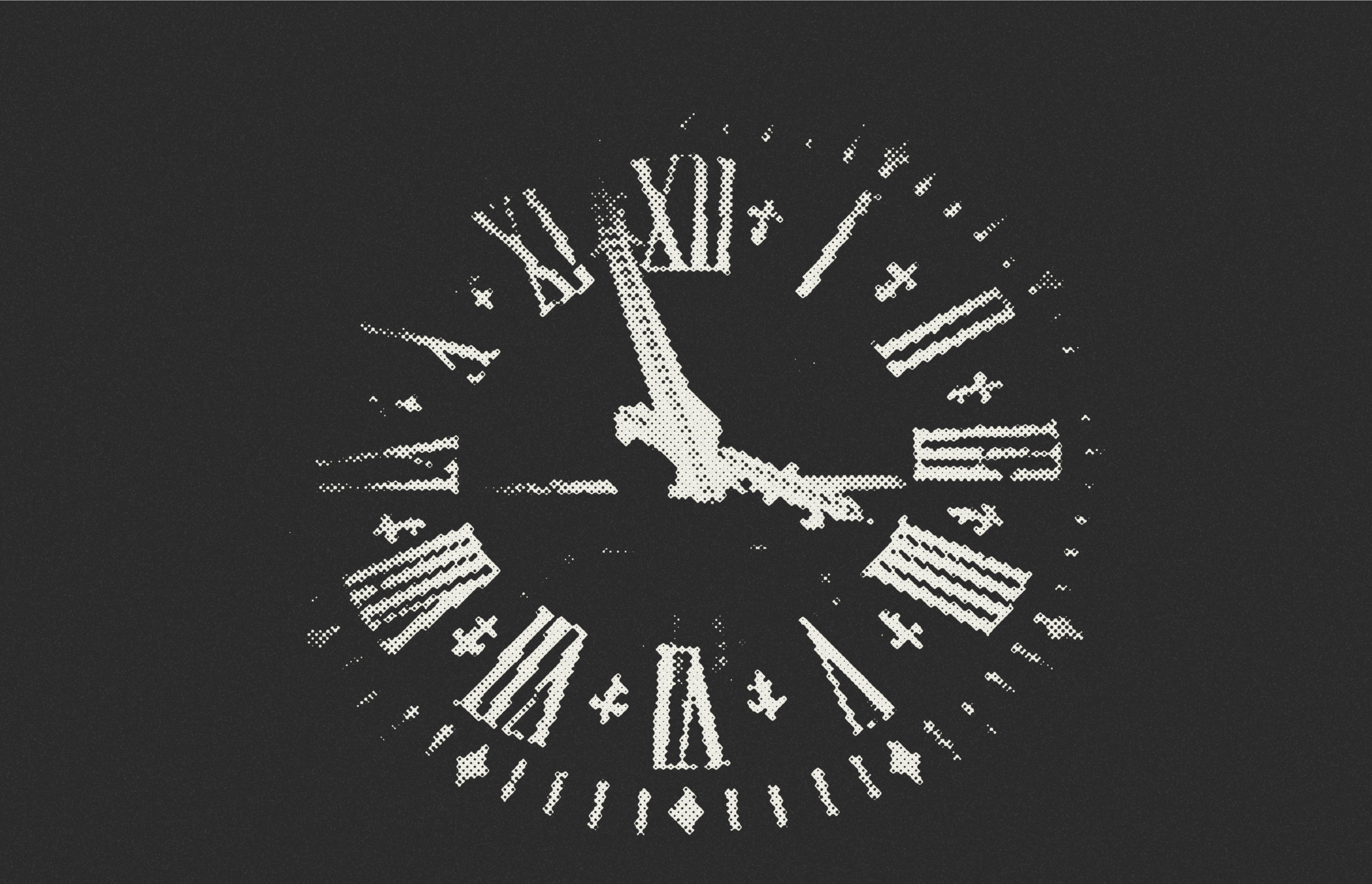
Before 1840, noon in Bristol happened about ten minutes after noon in London, and nobody much cared. The railway needed a common minute or it couldn't run - and that common minute is now a common nanosecond, shipped in real time.

How we lost the living Now

In 1840, England’s Great Western Railway started running the trains on “railway time” - a single standard, set by Greenwich, instead of the local // solar time each town had kept, independently for centuries.

Before the railway, noon in Bristol happened roughly ten minutes after noon in London, and nobody much gave a damn - they had no reason to. Time was...time. After the railway, people had to care - because a train leaving Paddington at 12 couldn’t mean one thing in London and another thing in Reading, or the passengers would miss it, or the signalmen would have no ability to coordinate, and the whole apparatus would fall apart.

That moment is, I believe, when we started losing our hold on the present.

Before the railway, time belonged to the place where you stood. Your noon was the noon of the sun over your head; a farmer in Wiltshire and a clerk in Liverpool would share a year, and a season, but they didn’t share a minute. The minute was solely the possession of your immediate surroundings, and you owned it.

But the railway needed a common minute - or it couldn’t run.

And then - once we had the common minute - we discovered that it could be commoditised. It could be bought and sold.

In 1911, Frederick Winslow Taylor turned the commoditisation of the minute into a science when he published The Principles of Scientific Management - which he had assembled by standing over the shoulder of various factory workers, wielding a stopwatch, breaking their labour into fractions of a minute. He calculated how long it should take to lift a pig iron bar, and how long to carry it across a yard, and how long to drop it onto a pile. He paid workers more, if they hit his numbers, and less if they “whiffed” - and he wrote all of this down in tables which became, eventually, an entire philosophy of industrial productivity...

Taylor’s “innovation” - if we can call it that - was treating a human’s time, and by extension their very mortality, as a commodity priced by the single second; and building on that foundation the idea that time, left unoptimised, was “theft.”

After Taylor, time was something you either used, or you wasted - no third option. The present moment became a quantity.

The telegraph had started this work 70-odd years before. Samuel Morse’s first public transmission in 1844 (“What Hath God Wrought”) collapsed the time between Baltimore and Washington, from days into seconds. The phone would collapse it further, and radio would collapse it for everyone all at once...

Every technological acceleration is framed as a gift of time to all mankind, but every acceleration arrives, in practice, with increased expectations, with increased demand, with more and more pressure. The letter you could answer on your time, became the telegram you had to answer today. The phone call you could ignore in 1950 (because you simply weren’t home to take it) became a call you had to return in 1985 because the answering machine upped the ante. Then the answering machine was replaced by your mobile phone and (insert montage of technological advances here) by 2026, a 2 hour delay replying to a Slack message became a social failure...

Hartmut Rosa, the German sociologist, wrote a book in 2005 called Beschleunigung - translated as Social Acceleration. It traces this pattern across 3 layers: tech acceleration speeds up the machines, acceleration of social change speeds up the rate at which institutions and relationships change, and the acceleration of the pace of life speeds up how much we can (or are forced to) cram into a single day. Rosa’s argument is that these layers feed off each other; faster machines let us change faster, which means we need faster machines to keep up, and the loop tightens, and so...

Well, here we are.

The original promise of acceleration was always more free time. Washing machines would give us more leisure, email would cut our labour, automation would give us a 4 day work week, and so on. None of this really happened; a rising floor of expected output swallowed the gains, and so we signed up for more, and we ended up running faster to stay in the same damn place.

And somewhere in the early 2000’s, this crossed a cursed threshold. Before that point, tech was mostly compressing the time between events - the telegram, and the fax, and the email and the IM each shortened the gap between when you sent something and when it arrived; the gap was the thing getting smaller and smaller.

After the smartphone, the gap just...vanished. The feed became real-time, and the notifications constant. Information stopped arriving as discrete, gapped packets and started arriving as a continuous drip, and then a steady flow, and then a firehose, timed by the network’s ambient activity and no longer by anything you happened to be doing. And suddenly, you weren’t receiving mail anymore. You were drowning in a raging river of information.

Paul Virilio, the philosopher, called the condition of real-time media an accident of time itself; he argued that when everything happens at once, nothing actually happens at all, because events lose their distinguishing temporal edges, and the past // present // future collapse into a single undifferentiated smear. A 2021 RescueTime study found that the average knowledge worker checked communication tools roughly every six minutes; other studies put the average smartphone user at around 2,000-3,000 touches per day. We interrupt ourselves, or we get interrupted, enough that sustained attention has become a minority activity. It no longer happens naturally; if it happens at all, it must be scheduled.

Each notification is a tax on the present moment - pulling you into either a micro-past (what did I just see?) or a micro-future (what should I do about this?) while the here and now is skipped over like the intro to a Netflix show. And ironically - we consented to this. We signed up for it without thinking twice. The telegram was imposed on us by commerce, the factory clock by management, but we installed and embraced the push notifications ourselves, app by app, in exchange for convenience - in exchange for acceleration - in exchange for collapse.

If the Now has any place at all, it’s as “content.” We watch an event happen, and we’re already narrating it for a future audience, for a draft post, for a video - as if the event itself isn’t quite real, until it has been recorded in some way. Call it what you want; but it describes a condition in which our tools have trained us to convert the present into its sole acceptable format. It becomes raw material for a feed. You’re standing inside it and outside of it, holding a lens and prepping a caption.

The French sociologist Henri Lefebvre wrote in 1947 about the colonisation of everyday life. He saw the structure of a world that would eventually (perhaps, inevitably) produce Instagram. Commerce, and then bureaucracy each laid claim to a bigger piece of the ordinary everyday, until the ordinary itself became a product. A few decades later, we started calling that product “content.” Not a bad word for it, actually, considering that Content only has to be Contained - it doesn’t have to offer anything of value on its own.

We know this is happening - all of us. We talk about it constantly - I just did, and you just read it, and we both probably felt briefly quite pleased with ourselves for noticing, and that’s part of the problem too...every other bestseller is about mindfulness and slow living, digital detoxes and offline retreats, sabbath practices and meditation apps that send you push notifications reminding you to experience the moment.

Silence is a malfunction. Grief is harder now, because to grieve means to sit inside a moment, and we’ve lost the practice of it. Joy is thinner, because joy needs a present it can occupy, and the present has been divided into micro-slices already claimed by the next scroll, the next ping, and the next thing we should be looking at instead...

The generational data is looking bleak.

In his 2024 book The Anxious Generation, Jonathan Haidt argued that the cohort born after 1995 - the first to get smartphones before they were fully developed - show a sharp increase in anxiety, depression and self-harm; and the increase tracks against the rollout of social media. Haidt’s causal story might be contested, but the numbers aren’t. We’re all a little broken. We’re all breaking a little more.

My own take is that it’s not only about screen time, it’s about a generation who never had the chance to experience a present moment, without a second channel running underneath it all. The backchannel of the phone, the draft message, the group chat, the algorithm etc is all humming under whatever is supposedly happening in the room, until the hum gets so loud it takes over everything else. A childhood of partial presence creates an adulthood where you can’t watch Sabrina Carpenter and Madonna share the stage without the intermediate of an iPhone camera and screen...

The older generations lost the present slowly, and can still remember what it was like to have one. The younger are trying to reconstruct it from second principles, if at all.

I have no program to offer here. The essays that end with a neat 5-step plan to reclaim attention are almost without exception published by those who sell courses, and may my bank account forgive me, I still don’t have such a product. I do think the present can return in small pockets, and under specific conditions - when you make something with your hands, and the thing resists, when you’re looking after your friend’s dog, who is the best dog in the world, who has no opinion about the future, in the middle of a long walk and after the internal monologue has run out of fresh grievances...

It returns when the compressors and the accelerators are out of reach for long enough that your nervous system remembers it has other settings.

The railway clock runs across server farms in places you have probably never been and will probably never go. The minute is measured by atomic oscillation and shopped out, in real time, to the watch on your wrist, the phone in your pocket, the Tesla in your driveway, the smart fridge that can tweet better than it can moderate its internal temperature etc., synced to the same atomic pulse.

It’s the same common minute. But it’s only ever the minute gone by or the minute yet to come. The minute we used to have and hold is gone.

SPONSORED

Westenberg is designed, built and funded by my solo-powered agency, Studio Self. Reach out and work with me:

Work with me
$ cat ./comments
About/// Self/// RSS/// Tools/// YouTube/// Forum/// About/// Self/// RSS/// Tools/// YouTube/// Forum/// About/// Self/// RSS/// Tools/// YouTube/// Forum/// About/// Self/// RSS/// Tools/// YouTube/// Forum///